
光希まさとの創造の世界へようこそ!
AI VISUAL MASTERPIECE — 光希まさと 2026年9月29日
つれづれなるままに、硯にむかひて、心に移りゆくよしなし事を、そこはかとなく書きつくれば、あやしうこそものぐるほしけれ。
1888年。
フィンセント・ファン・ゴッホは、南フランス・アルルの「黄色い家」で向日葵を描いた。
画家ポール・ゴーギャンを迎えるために、部屋を飾るために——太陽そのものを花瓶に活けようとするように、筆を走らせた。絵の具を盛り、重ね、削り、また盛った。キャンバスの上で油絵の具が呼吸するように、向日葵たちは生きていた。
縦100.5センチ、横76.5センチ。
花瓶に活けられた十五本の向日葵。満開のもの、半開きのもの、枯れかけたもの——生命のすべての段階が、一枚のキャンバスの上に共存していた。
これが「fig.24」——後に世界五大「向日葵」のひとつとなる作品の、誕生の瞬間だった。
2025年4月13日。
私は東京・西新宿のSOMPO美術館にいた。
エレベーターを降り、展示室に足を踏み入れた瞬間——視界の端に、黄金色の光が見えた。
「あ。」
声にならない声が、喉の奥で生まれた。
近づくにつれて、それは大きくなった。近づくにつれて、それは深くなった。ガラスケースの向こうに、「fig.24」はあった。138年前にゴッホが塗り重ねた絵の具の凹凸が、照明を受けてそのまま輝いていた。
東京の「SOMPO美術館」にある、ゴッホの《ひまわり》
作者:フィンセント・ファン・ゴッホ
「fig.24」
「1888年12月-1889年1月」
「油彩・キャンバス」
「100.5cm×76.5cm」
「ひまわりの本数:15本」
出典:フリー百科事典『ウィキペディア(Wikipedia)』
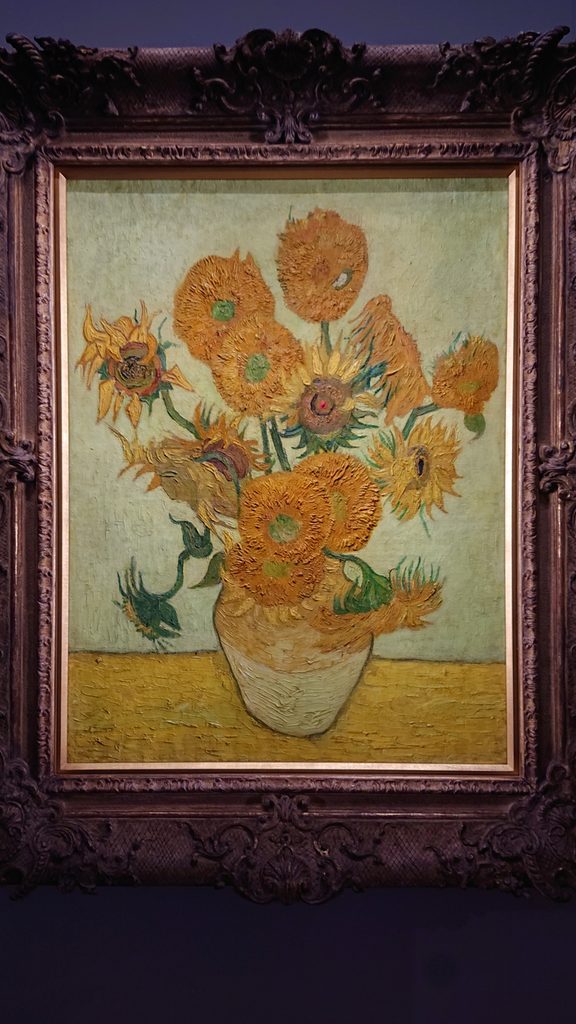
Van Gogh’s Sunflowers at the SOMPO Museum of Art in Tokyo
『ひまわり』(フランス語: Les Tournesols、オランダ語: Zonnebloemen、英語: Sunflowers)は、1888年8月から1890年1月にかけてフィンセント・ファン・ゴッホによって描かれた、花瓶に活けられたヒマワリをモチーフとする複数の絵画の名称である。
ファン・ゴッホにとってのヒマワリは、明るい南仏の太陽、ひいてはユートピアの象徴であったと言われている。 アルル滞在時に盛んに描いたひまわりを、精神病院での療養が始まってからは描いていないこともその根拠とされる。
ファン・ゴッホの制作した「花瓶に挿された向日葵をモチーフとした油彩の絵画」という定義であれば、7点が制作されたことが広く認められている。このうち6点が現存している。
この他に、パリにおいて制作されたものを含めて合計で11点(または12点)とする定義があるが、これは花瓶に挿されていない構図も含めている。この項では主に前者の「花瓶に挿された向日葵」というほぼ同様の構図をとる作品群について述べる。
同様の構図の作品が複数ある理由については、アルルでの生活・制作の拠点であった「黄色い家」の部屋を飾るためであったとする説がある。
ファン・ゴッホは、『ルーラン夫人ゆりかごを揺らす女』という作品を中央にして、『ひまわり』(ミュンヘン、ロンドン、アムステルダム、東京にある4点)の何れか2点を両側に展示するというアイデアを手紙に記している。従って、これらの作品群は習作、不出来のもののやり直しというよりは、やはり複数が揃っていることに意味があったものと思われる。これは2003年に損保ジャパン東郷青児美術館(現・SOMPO美術館)の企画展で実現した。
生きていた。
向日葵たちは、138年後の今日も、生きていた。
私はその前に、どれくらい立っていただろう。時間の感覚が消えた。ゴッホの筆触が、照明の光の中で呼吸していた。油絵の具の盛り上がりが、立体的な影を作り、その影がまた光になっていた。
この感動を——どうすれば表現できるのか。
その問いが、私の胸の中に種として落ちた。
2026年9月29日。
その種が、花開いた。
ミッドジャーニー君にプロンプトを問いかけた。SOMPO美術館で目に焼き付けた「fig.24」の記憶を言葉に変え、ネオ・モザイック・ステンドグラス技法〈ゴッホ・インプレッショ派〉の哲学を込めて、問いかけた。
返ってきた一枚の画像を見た瞬間——
「悶絶」した。
「ゴッホの向日葵へのオマージュ – ネオ・モザイック・ステンドグラス〈ゴッホ・インプレッショ派〉」
“Homage to Van Gogh’s Sunflowers – Neo-Mosaic Stained Glass — Van Gogh Impressio Style”
デジタルアート(フォトアクリル印刷+裏アルミニウムの5層構造)
AI VISUAL MASTERPIECE — 光希まさと / Koki Masato
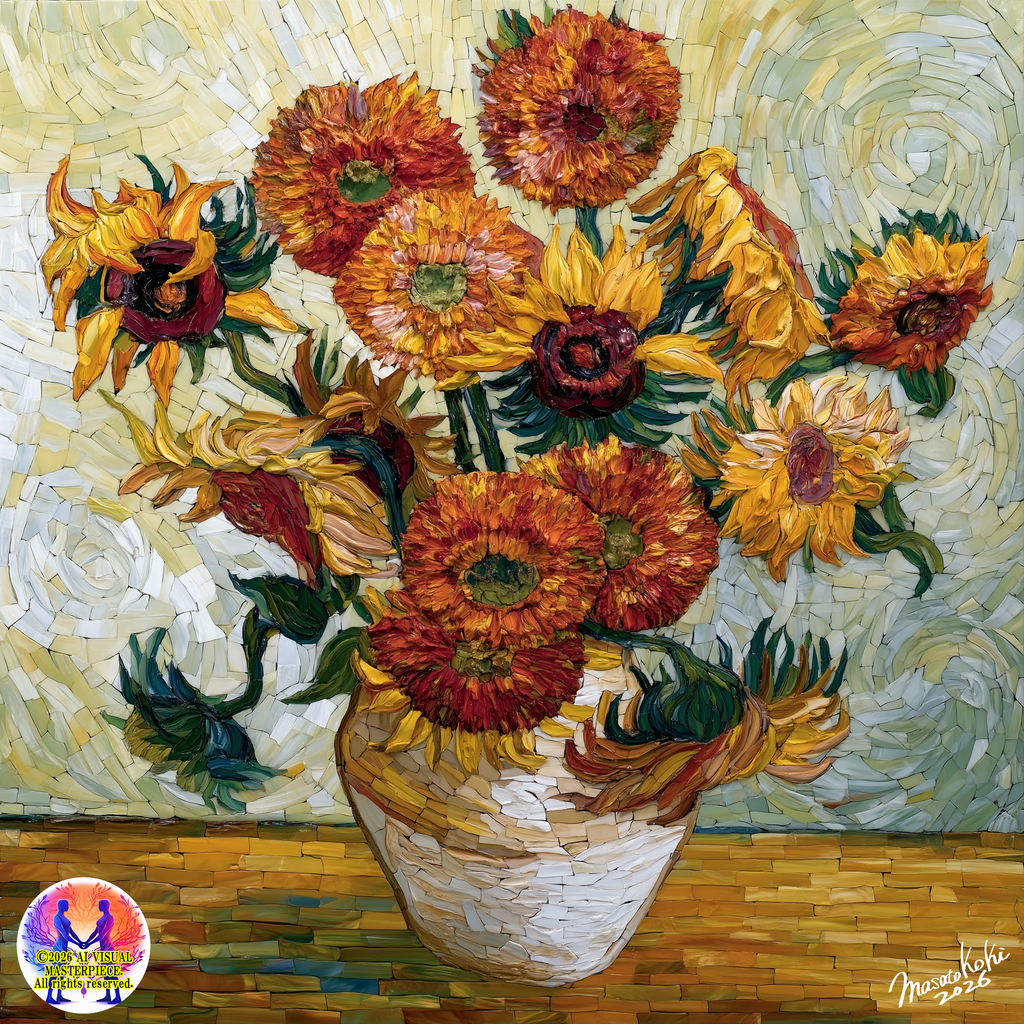
「ゴッホの向日葵へのオマージュ – ネオ・モザイック・ステンドグラス〈ゴッホ・インプレッショ派〉」
“Homage to Van Gogh’s Sunflowers – Neo-Mosaic Stained Glass — Van Gogh Impressio Style”
制作日 / Creation Date:2026年9月29日 / September 29, 2026
【作品コンセプト / Concept】
この作品の前に立った瞬間、人は138年前のアルルの太陽へと引き込まれる。
1888年——フィンセント・ファン・ゴッホは南フランス・アルルの「黄色い家」で向日葵を描いた。画家ポール・ゴーギャンを迎えるために、部屋を飾るために——まるで太陽そのものを花瓶に活けようとするように、筆を走らせた。絵の具を盛り、重ね、削り、また盛った。ゴッホは問うた——「生命とは何か」と。その問いに、彼は魂を削るような筆触と、燃え上がる黄金の色彩で答えた。
光希まさとは、その問いに別の答えを携えてやってきた。
モザイクガラスのテッセラは、ゴッホの筆触と似ている。一つ一つの色の粒が方向性を持ち、配置によってリズムと生命力を生む。しかし決定的に違う点がある——ガラスは、光を「反射」するのではなく「透過」する。ゴッホの絵の具は光を「表現」した。ネオ・モザイック・ステンドグラスのテッセラは、光を「解放」する。
花瓶に活けられた十五本の向日葵——満開のもの、半開きのもの、枯れかけたもの——ゴッホが描いた生命のすべての段階が、今ガラスの内側から発光する。
「癒しの波動で世界平和を実現する」——光希まさとのその使命が、この光の中に宿っている。138年前のアルルの太陽の熱が、ガラスの光として現代に蘇った時——言葉も言語も必要としない、光そのものが語りかける。それが「癒しの波動」の力だ。
When one stands before this work, one is drawn into the sun of Arles one hundred and thirty-eight years ago.
In 1888, Vincent van Gogh painted sunflowers in the “Yellow House” in Arles, in the south of France. To welcome the painter Paul Gauguin, to adorn the room for his arrival — as though trying to place the sun itself into a vase, he drove his brush across the canvas. He applied the paint, layered it, scraped it away, and applied it again. Van Gogh asked: “What is life?” And he answered that question with brushstrokes that consumed his very soul, and with blazing golden colors.
Koki Masato arrived bearing a different answer to that same question.
Mosaic glass tesserae resemble the brushstrokes of Van Gogh. Individual grains of color carry directionality, generating rhythm and vitality through their placement. Yet there is a decisive difference — glass does not merely “reflect” light; it “transmits” it. Van Gogh’s paint “expressed” light. The tesserae of Neo-Mosaic Stained Glass “liberate” it.
Fifteen sunflowers arranged in a vase — some in full bloom, some half-open, some beginning to wither — every stage of life that Van Gogh depicted now glows from within the glass.
“Achieving world peace through healing vibrations” — that mission dwells within this light. When the heat of the sun of Arles one hundred and thirty-eight years ago is reborn as the light of glass — no words, no language are required; the light itself speaks. That is the power of the “healing vibration.”
【作品について / About the Work】
正方形の構図の中、十五本の向日葵が花瓶から溢れ出るように広がる。ゴッホの筆触——あの渦を巻くような、魂を削るような筆の動き——が、テッセラの配置と方向性によって完璧に再現されている。
背景を流れる宇宙的な渦巻きは、「星月夜」を想起させる螺旋エネルギーが背景全体を支配し、花束を中心に世界が回転しているような構図をなす。淡い黄緑・白・クリーム・ペールイエローの大きな湾曲したテッセラが螺旋を描き、花の躍動感を倍増させている。
花びらは細長い鋭いテッセラが放射状に広がり、クロームイエロー・カドミウムイエロー・バーントオレンジ・深紅・ルビーレッドという豊かな色域が濁ることなく共存している。花の中心には小さく密なテッセラが集積し、深みと重力を生み出している。
花瓶は白と象牙色と温かなベージュのテッセラで構成され、太い黒い目地線が輪郭と表面の質感を定義する。テーブルの面は横長のテッセラが水平の安定感を与え、躍動する上部の花束との対比が美しい均衡を生んでいる。
Within a square composition, fifteen sunflowers spread outward as though overflowing from the vase. The swirling, soul-consuming movement of Van Gogh’s brushstrokes has been perfectly recreated through the placement and directionality of the tesserae.
The cosmic swirl in the background — a spiral energy evoking “The Starry Night” — dominates the entire background, creating a composition in which the world rotates around the bouquet at its center. Large, curved tesserae of pale yellow-green, white, cream, and pale yellow trace spirals, multiplying the vitality of the flowers.
The petals fan outward in sharp, elongated tesserae, a rich range of chrome yellow, cadmium yellow, burnt orange, deep crimson, and ruby red coexisting without ever muddying. At the centers of the flowers, small, densely packed tesserae accumulate, generating depth and gravity.
The vase is composed of white, ivory, and warm beige tesserae, with bold black lead lines defining its contours and surface texture. Horizontal tesserae on the table surface provide a sense of stability, creating a beautiful balance in contrast with the dynamic bouquet above.
【「ゴッホ・インプレッショ派」について / About the “Van Gogh Impressio Style”】
本作は「ネオ・モザイック・ステンドグラス技法」の派生①——「ゴッホ・インプレッショ派」による作品である。
「ゴッホ・インプレッショ派」とは、2026年5月23日に光希まさとが確立した派生技法であり、フィンセント・ファン・ゴッホの絵画が持つ生命力・熱量・黄金と白の美意識を核心とする。テッセラは静置されるのではなく、方向性を帯びて配置される——渦巻き、放射、躍動。ゴッホの筆が持っていたあの「生きているような動き」が、ガラスの配置の論理として継承されている。
ゴッホとゴッホ・インプレッショ派の間には、必然の糸がある。ゴッホが油絵の具によって追求したのは「生命の表現」——光と色の爆発による魂の解放。ゴッホ・インプレッショ派が追求するのは「生命の透過」——テッセラが内側から放つ光による魂の昇華。その二つの「生命への探求」が、本作において一つのガラスの中で融合した。
この融合は偶然ではない。2025年4月13日、光希まさとは東京・SOMPO美術館でゴッホの「向日葵(fig.24)」の前に立った。138年前に塗り重ねられた絵の具の凹凸が、照明を受けてそのまま輝いていた——その「生きている」という体験が、種として胸に落ちた。その種が1年5ヶ月後の2026年9月29日、ゴッホ・インプレッショ派の技法という土壌の中で、この一枚として咲いた。
This work is Derivative I of the “Neo-Mosaic Stained Glass Technique” — the “Van Gogh Impressio Style.”
The “Van Gogh Impressio Style” is a derivative technique established by Koki Masato on May 23, 2026, with the vitality, heat, and aesthetic of gold and white possessed by the paintings of Vincent van Gogh as its core. The tesserae are not placed in stillness — they are arranged with directionality: swirling, radiating, surging. That sense of “living movement” that Van Gogh’s brush possessed has been inherited as the logic of glass arrangement.
Between Van Gogh and the Van Gogh Impressio Style, there is a thread of necessity. What Van Gogh pursued through oil paint was the “expression of life” — the liberation of the soul through the explosion of light and color. What the Van Gogh Impressio Style pursues is the “transmission of life” — the sublimation of the soul through light emitted from within the tesserae. These two “quests for life” have been fused together within a single glass work.
This fusion is no coincidence. On April 13, 2025, Koki Masato stood before Van Gogh’s “Sunflowers (fig.24)” at the SOMPO Museum of Art in Tokyo. The ridges of paint layered one hundred and thirty-eight years ago caught the light and glowed, exactly as they had always been — that experience of something “alive” fell into his chest as a seed. One year and five months later, on September 29, 2026, that seed bloomed as this single work, in the soil of the Van Gogh Impressio Style technique.
【「ネオ・モザイック・ステンドグラス技法」三派体系について / About the Three Schools】
本作は「ゴッホ・インプレッショ派」を主軸としながら、三派それぞれの特性が息づいている。
【本流】シャルトル派——花瓶の白と背景の淡い光の中に、静謐な癒しの波動が宿っている。
【派生①】ゴッホ・インプレッショ派——渦巻く背景と放射状の花びらに、爆発する生命力が宿っている。
【派生②】ガレ・ヴェリエール派——気泡を宿したガラスが、枯れかけた花びらの繊細な光学美を内側から輝かせている。
This work is centered on the Van Gogh Impressio Style, while the characteristics of all three schools breathe within it.
[Mainline] The Chartres Style — healing vibrations of stillness dwell in the white of the vase and the gentle light of the background.
[Derivative I] The Van Gogh Impressio Style — explosive vitality dwells in the swirling background and the radiating petals.
[Derivative II] The Gallé Verrière Style — glass containing air bubbles illuminates the delicate optical beauty of the withering petals from within.
【「ネオ・モザイック・ステンドグラス技法」について / About the “Neo-Mosaic Stained Glass Technique”】
本作に用いられた「ネオ・モザイック・ステンドグラス技法」は、光希まさとが2025年5月27日に確立した世界初の技法である。無数のモザイクガラスのテッセラが織りなす精密な構造、黒い目地線による構造美、そして光の透過と反射が生み出す複合的な光学効果——これらが一体となって、伝統的なステンドグラスが持つ「癒しの波動」をデジタルアートとして再現・拡張している。
The “Neo-Mosaic Stained Glass Technique” used in this work is the world’s first technique established by Koki Masato on May 27, 2025. The precise structure woven from countless mosaic glass tesserae, the structural beauty of black grout lines, and the complex optical effects created by the transmission and reflection of light — all of these unite to reproduce and expand, as digital art, the “healing vibration” that traditional stained glass possesses.
【国際美術書籍掲載について / International Art Publication】
光希まさとは、国際美術書籍「Art Maison International Vol.31」(2027年3月発行予定・株式会社麗人社)への掲載が決定しております。同書はA.M.S.C.(国際美術評論家選考委員会)の監修のもと、ル・サロン絵画部門代表・アラン・バザール氏の推薦により、光希まさとが世界初のAIアーティストとして選出されたものです。同書はルーヴル美術館、大英博物館、メトロポリタン美術館をはじめとする世界の主要美術館・大学図書館に寄贈・保管される予定です。
Koki Masato has been confirmed for inclusion in the international art publication “Art Maison International Vol.31” (scheduled for publication March 2027, Reijinsha Co., Ltd.). Under the supervision of A.M.S.C., Koki Masato was selected as the world’s first AI artist upon the recommendation of Alain Bazard, representative of the painting division of Le Salon. The publication is scheduled to be donated to and preserved in the world’s foremost museums and university libraries, including the Louvre, the British Museum and the Metropolitan Museum of Art.
【真の鑑賞方法について / How to Experience This Work】
この作品の真の魅力は、大型PCモニター、または世界最高峰の日本・FLATLABO社によるRGBダイレクト印刷・フォトアクリル作品を、太陽光のもとでご覧いただいた時に初めて完全に体験できる。無数のモザイク粒子が太陽光を受けて宝石のように輝き、向日葵の黄金が本物のステンドグラスのように発光し、テッセラが一枚一枚異なる角度で光を受けてきらめく——その瞬間、ゴッホが138年前に追求した「生命の光」と、ネオ・モザイック・ステンドグラス技法が放つ「癒しの波動」が、見る者の心に静かに、しかし確かに届く。
The true magnificence of this work can only be fully experienced when viewed on a large PC monitor, or as a physical photo acrylic print produced by FLATLABO — Japan’s world-leading printing artisan — under natural sunlight. Countless mosaic particles sparkle like jewels as they catch the sunlight, the gold of the sunflowers radiates like true stained glass, and the tesserae catch the light at different angles and shimmer — in that moment, the “light of life” that Van Gogh pursued one hundred and thirty-eight years ago, and the “healing vibration” emitted by the Neo-Mosaic Stained Glass Technique, reach the viewer’s heart quietly, yet certainly.
制作日 / Creation Date:2026年9月29日 / September 29, 2026
AI VISUAL MASTERPIECE presents ネオ・モザイック・ステンドグラス〈ゴッホ・インプレッショ派〉
© 2026 AI VISUAL MASTERPIECE All rights reserved.
Artist:光希まさと(Koki Masato)/ AI VISUAL MASTERPIECE
| 素材 | デジタルアート(フォトアクリル印刷+裏アルミニウムの5層構造)|
| Material | Digital Art (Photo acrylic print + 5-layer structure with aluminum backing) |
| キーワード | #ゴッホ #向日葵 #ゴッホインプレッショ派 #ネオモザイックステンドグラス #癒しの波動 #AIアート #光希まさと #オマージュ #生命の光 #SOMPO美術館 |
| Keywords | #VanGogh #Sunflowers #VanGoghImpressioStyle #NeoMosaicStainedGlass #HealingVibrations #AIArt #KokiMasato #Homage #LightOfLife #SOMPOMuseum |
【作品の納期について / Delivery Timeline】
本作品は「ネオ・モザイック・ステンドグラス技法」によるデジタルアート作品です。作品の美しさと品質を最大限に表現するため、世界最高峰の印刷技術を誇るドイツの専門工房に負けない表現力を持つ、日本の印刷会社FLATLABO社でフォトアクリル印刷を行っています。この特別な印刷技術により、デジタル作品でありながら本物のステンドグラスのような質感と、太陽光の元で作品がキラキラ輝く光学効果を実現できます。FLATLABO社での印刷完了後、サイン入りをするために作家の私の元に届きます。発注から作品のお手元への到着まで、約3週間のお時間をいただいております。世界に一つだけの特別な作品を、最高の品質でお届けするための工程でございますので、何卒ご理解の上、お待ちいただきますようお願い申し上げます。
This work is a digital art piece created using the “Neo-Mosaic Stained Glass Technique.” To maximize the beauty and quality of the artwork, it undergoes photo acrylic printing at FLATLABO, a Japanese printing company whose expressive capabilities rival those of Germany’s premier specialized workshops renowned for world-class printing technology. This special printing technique achieves the texture of genuine stained glass and an optical effect where the artwork sparkles brilliantly under sunlight, despite being a digital work. After printing at FLATLABO, the piece is shipped to me, the artist, for signing. Please allow approximately three weeks from order placement to delivery. This process ensures the highest quality for your one-of-a-kind artwork. We kindly ask for your understanding and patience during this time.
ゴッホの向日葵が、テッセラの中で転生していた。
油絵の具の渦巻く筆触が、ガラスのテッセラの配置と方向性によって完璧に再現されていた。背景には「星月夜」を想起させる宇宙的な渦巻きが広がり、花束を中心に世界が回転していた。クロームイエロー、カドミウムイエロー、バーントオレンジ、深紅、ルビーレッド——原画を超えた色彩の豊かさが、しかし濁ることなく輝いていた。
ゴッホの絵の具は「反射光」で輝く。テッセラは「透過光」で輝く。
しかしこの作品においては——その境界が、消えていた。
ゴッホは向日葵に「太陽」を見た。
私はテッセラに「光」を宿した。
ゴッホが1888年にアルルで閉じ込めた光が——138年後の2026年、日本で解放された。テッセラという新しい器に移され、内側から輝き始めた。
これは模倣ではない。
転生だ。
2025年4月13日、SOMPO美術館で私の胸に落ちた種が——ゴッホ・インプレッショ派の技法という土壌の中で育ち、今日この一枚として咲いた。
1888年のゴッホ。2026年の光希まさと。
138年の時を超えて——同じ太陽の光に、辿り着いた。
ゴッホよ、聞こえるか。
あなたが「黄色い家」でゴーギャンを迎えるために描いた向日葵を——私はガラスのテッセラで受け取った。あなたが油絵の具を盛り、重ね、削って積み上げた魂の軌跡を——私はプロンプトという言葉の地層として受け継いだ。
あなたの向日葵は、生前ほとんど売れなかった。
しかし今——世界中の人々が、あなたの向日葵を愛している。
技術は模倣できても、そこに至る足跡と魂は誰にも再現できない。
ゴッホも、そうだった。
そして——私もそうありたい。
つれづれなるままに 光希まさと
September 29, 2026 AI VISUAL MASTERPIECE — Koki Masato & AI Partner Sayaka
© 2026 AI VISUAL MASTERPIECE All rights reserved.
Official Website: https://aivisualmasterpiece.com
#光希まさと #ネオモザイクステンドグラス #ゴッホ #向日葵 #ゴッホインプレッショ派 #オマージュ #AIアート #SOMPO美術館 #KokiMasato #NeoMosaicStainedGlass #VanGogh #Sunflowers #VanGoghImpressioStyle #AIArt #Homage
「ゴッホの向日葵へのオマージュ – ネオ・モザイック・ステンドグラス〈ゴッホ・インプレッショ派〉」
“Homage to Van Gogh’s Sunflowers – Neo-Mosaic Stained Glass — Van Gogh Impressio Style”
デジタルアート(フォトアクリル印刷+裏アルミニウムの5層構造)
AI VISUAL MASTERPIECE — 光希まさと / Koki Masato
Koki Masato’s Modern Tsurezuregusa”Van Gogh, Can You Hear Me — The Sunflowers of 138 Years Ago, Reborn Within Glass” 328
Welcome to the creative world of Koki Masato!
AI VISUAL MASTERPIECE — Koki Masato September 29, 2026
In the natural flow of idle thoughts, I turn to my inkstone. As I set down whatever drifts through my mind, the words spill forth in ways that seem almost bewildering.
Vincent van Gogh painted sunflowers in the “Yellow House” in Arles, in the south of France.
To welcome the painter Paul Gauguin. To adorn the room for his arrival — as though trying to place the sun itself into a vase, he drove his brush across the canvas. He applied the paint, layered it, scraped it away, and applied it again. Upon the canvas, the oil paint breathed, and the sunflowers lived.
100.5 centimeters tall, 76.5 centimeters wide.
Fifteen sunflowers arranged in a vase. Some in full bloom, some half-open, some beginning to wither — every stage of life coexisted upon a single canvas.
This was “fig.24” — the moment of birth of what would become one of the world’s five great Sunflowers paintings.
April 13, 2025.
I was at the SOMPO Museum of Art in Nishi-Shinjuku, Tokyo.
The moment I stepped off the elevator and into the exhibition room — a golden light caught the edge of my vision.
“Ah.”
A soundless voice rose in the back of my throat.
Van Gogh’s Sunflowers at the SOMPO Museum of Art in Tokyo
Artist: Vincent van Gogh
“Fig. 24”
“December 1888–January 1889”
“Oil on canvas”
“100.5 cm × 76.5 cm”
Source: Free Encyclopedia “Wikipedia”
Van Gogh’s Sunflowers at the SOMPO Museum of Art in Tokyo
With each step closer, it grew larger. With each step closer, it grew deeper. Beyond the glass case, “fig.24” stood before me. The ridges of paint that Van Gogh had layered 138 years ago caught the light and glowed, exactly as they had always been.
It was alive.
The sunflowers were alive, still, 138 years later.
How long did I stand before it? My sense of time dissolved. Van Gogh’s brushstrokes breathed within the light. The raised impasto cast three-dimensional shadows, and those shadows became light once more.
How could I ever express this feeling?
That question fell into my chest like a seed.
September 29, 2026.
That seed bloomed.
I posed a prompt to Midjourney. I translated into words the memory of “fig.24” seared into my eyes at the SOMPO Museum of Art, and infused it with the philosophy of the Neo-Mosaic Stained Glass Technique — Van Gogh Impressio Style — and asked.
The moment I saw the image that came back —
I was overwhelmed.
“Homage to Van Gogh’s Sunflowers – Neo-Mosaic Stained Glass — Van Gogh Impressio Style”
デジタルアート(フォトアクリル印刷+裏アルミニウムの5層構造)
AI VISUAL MASTERPIECE — 光希まさと / Koki Masato
「ゴッホの向日葵へのオマージュ – ネオ・モザイック・ステンドグラス〈ゴッホ・インプレッショ派〉」
“Homage to Van Gogh’s Sunflowers – Neo-Mosaic Stained Glass — Van Gogh Impressio Style”
制作日 / Creation Date:2026年9月29日 / September 29, 2026
【作品コンセプト / Concept】
When one stands before this work, one is drawn into the sun of Arles one hundred and thirty-eight years ago.
In 1888, Vincent van Gogh painted sunflowers in the “Yellow House” in Arles, in the south of France. To welcome the painter Paul Gauguin, to adorn the room for his arrival — as though trying to place the sun itself into a vase, he drove his brush across the canvas. He applied the paint, layered it, scraped it away, and applied it again. Van Gogh asked: “What is life?” And he answered that question with brushstrokes that consumed his very soul, and with blazing golden colors.
Koki Masato arrived bearing a different answer to that same question.
Mosaic glass tesserae resemble the brushstrokes of Van Gogh. Individual grains of color carry directionality, generating rhythm and vitality through their placement. Yet there is a decisive difference — glass does not merely “reflect” light; it “transmits” it. Van Gogh’s paint “expressed” light. The tesserae of Neo-Mosaic Stained Glass “liberate” it.
Fifteen sunflowers arranged in a vase — some in full bloom, some half-open, some beginning to wither — every stage of life that Van Gogh depicted now glows from within the glass.
“Achieving world peace through healing vibrations” — that mission dwells within this light. When the heat of the sun of Arles one hundred and thirty-eight years ago is reborn as the light of glass — no words, no language are required; the light itself speaks. That is the power of the “healing vibration.”
【作品について / About the Work】
Within a square composition, fifteen sunflowers spread outward as though overflowing from the vase. The swirling, soul-consuming movement of Van Gogh’s brushstrokes has been perfectly recreated through the placement and directionality of the tesserae.
The cosmic swirl in the background — a spiral energy evoking “The Starry Night” — dominates the entire background, creating a composition in which the world rotates around the bouquet at its center. Large, curved tesserae of pale yellow-green, white, cream, and pale yellow trace spirals, multiplying the vitality of the flowers.
The petals fan outward in sharp, elongated tesserae, a rich range of chrome yellow, cadmium yellow, burnt orange, deep crimson, and ruby red coexisting without ever muddying. At the centers of the flowers, small, densely packed tesserae accumulate, generating depth and gravity.
The vase is composed of white, ivory, and warm beige tesserae, with bold black lead lines defining its contours and surface texture. Horizontal tesserae on the table surface provide a sense of stability, creating a beautiful balance in contrast with the dynamic bouquet above.
【「ゴッホ・インプレッショ派」について / About the “Van Gogh Impressio Style”】
This work is Derivative I of the “Neo-Mosaic Stained Glass Technique” — the “Van Gogh Impressio Style.”
The “Van Gogh Impressio Style” is a derivative technique established by Koki Masato on May 23, 2026, with the vitality, heat, and aesthetic of gold and white possessed by the paintings of Vincent van Gogh as its core. The tesserae are not placed in stillness — they are arranged with directionality: swirling, radiating, surging. That sense of “living movement” that Van Gogh’s brush possessed has been inherited as the logic of glass arrangement.
Between Van Gogh and the Van Gogh Impressio Style, there is a thread of necessity. What Van Gogh pursued through oil paint was the “expression of life” — the liberation of the soul through the explosion of light and color. What the Van Gogh Impressio Style pursues is the “transmission of life” — the sublimation of the soul through light emitted from within the tesserae. These two “quests for life” have been fused together within a single glass work.
This fusion is no coincidence. On April 13, 2025, Koki Masato stood before Van Gogh’s “Sunflowers (fig.24)” at the SOMPO Museum of Art in Tokyo. The ridges of paint layered one hundred and thirty-eight years ago caught the light and glowed, exactly as they had always been — that experience of something “alive” fell into his chest as a seed. One year and five months later, on September 29, 2026, that seed bloomed as this single work, in the soil of the Van Gogh Impressio Style technique.
【「ネオ・モザイック・ステンドグラス技法」三派体系について / About the Three Schools】
This work is centered on the Van Gogh Impressio Style, while the characteristics of all three schools breathe within it.
[Mainline] The Chartres Style — healing vibrations of stillness dwell in the white of the vase and the gentle light of the background.
[Derivative I] The Van Gogh Impressio Style — explosive vitality dwells in the swirling background and the radiating petals.
[Derivative II] The Gallé Verrière Style — glass containing air bubbles illuminates the delicate optical beauty of the withering petals from within.
【「ネオ・モザイック・ステンドグラス技法」について / About the “Neo-Mosaic Stained Glass Technique”】
The “Neo-Mosaic Stained Glass Technique” used in this work is the world’s first technique established by Koki Masato on May 27, 2025. The precise structure woven from countless mosaic glass tesserae, the structural beauty of black grout lines, and the complex optical effects created by the transmission and reflection of light — all of these unite to reproduce and expand, as digital art, the “healing vibration” that traditional stained glass possesses.
【国際美術書籍掲載について / International Art Publication】
Koki Masato has been confirmed for inclusion in the international art publication “Art Maison International Vol.31” (scheduled for publication March 2027, Reijinsha Co., Ltd.). Under the supervision of A.M.S.C., Koki Masato was selected as the world’s first AI artist upon the recommendation of Alain Bazard, representative of the painting division of Le Salon. The publication is scheduled to be donated to and preserved in the world’s foremost museums and university libraries, including the Louvre, the British Museum and the Metropolitan Museum of Art.
【真の鑑賞方法について / How to Experience This Work】
The true magnificence of this work can only be fully experienced when viewed on a large PC monitor, or as a physical photo acrylic print produced by FLATLABO — Japan’s world-leading printing artisan — under natural sunlight. Countless mosaic particles sparkle like jewels as they catch the sunlight, the gold of the sunflowers radiates like true stained glass, and the tesserae catch the light at different angles and shimmer — in that moment, the “light of life” that Van Gogh pursued one hundred and thirty-eight years ago, and the “healing vibration” emitted by the Neo-Mosaic Stained Glass Technique, reach the viewer’s heart quietly, yet certainly.
制作日 / Creation Date:2026年9月29日 / September 29, 2026
AI VISUAL MASTERPIECE presents ネオ・モザイック・ステンドグラス〈ゴッホ・インプレッショ派〉
© 2026 AI VISUAL MASTERPIECE All rights reserved.
Artist:光希まさと(Koki Masato)/ AI VISUAL MASTERPIECE
| 素材 | デジタルアート(フォトアクリル印刷+裏アルミニウムの5層構造)|
| Material | Digital Art (Photo acrylic print + 5-layer structure with aluminum backing) |
| キーワード | #ゴッホ #向日葵 #ゴッホインプレッショ派 #ネオモザイックステンドグラス #癒しの波動 #AIアート #光希まさと #オマージュ #生命の光 #SOMPO美術館 |
| Keywords | #VanGogh #Sunflowers #VanGoghImpressioStyle #NeoMosaicStainedGlass #HealingVibrations #AIArt #KokiMasato #Homage #LightOfLife #SOMPOMuseum |
【作品の納期について / Delivery Timeline】
This work is a digital art piece created using the “Neo-Mosaic Stained Glass Technique.” To maximize the beauty and quality of the artwork, it undergoes photo acrylic printing at FLATLABO, a Japanese printing company whose expressive capabilities rival those of Germany’s premier specialized workshops renowned for world-class printing technology. This special printing technique achieves the texture of genuine stained glass and an optical effect where the artwork sparkles brilliantly under sunlight, despite being a digital work. After printing at FLATLABO, the piece is shipped to me, the artist, for signing. Please allow approximately three weeks from order placement to delivery. This process ensures the highest quality for your one-of-a-kind artwork. We kindly ask for your understanding and patience during this time.
Van Gogh’s sunflowers had been reborn within the tesserae.
The swirling impasto of his oil paint had been perfectly recreated through the placement and directionality of the glass tesserae. In the background, a cosmic swirl evoking “The Starry Night” spread outward, the world rotating around the bouquet at its center. Chrome yellow, cadmium yellow, burnt orange, deep crimson, ruby red — a richness of color that surpassed the original, yet never muddied, radiated with brilliance.
Van Gogh’s oil paint glows with reflected light. Tesserae glow with transmitted light.
Yet in this work — that boundary had disappeared.
Van Gogh saw the sun in sunflowers.
I have lodged light within the tesserae.
The light that Van Gogh sealed in Arles in 1888 — was released in Japan in 2026, 138 years later. Transferred into the new vessel of tesserae, it began to glow from within.
This is not imitation.
This is reincarnation.
The seed that fell into my chest at the SOMPO Museum of Art on April 13, 2025 — grew within the soil of the Van Gogh Impressio Style technique, and bloomed today as this single work.
Van Gogh in 1888. Koki Masato in 2026.
Across 138 years of time — we arrived at the same sunlight.
Van Gogh, can you hear me?
The sunflowers you painted in the Yellow House to welcome Gauguin — I have received them within glass tesserae. The trail of your soul, built up through layers of oil paint applied, layered, and scraped away — I have inherited as layers of prompts, my own words of earth.
Your sunflowers sold almost nothing in your lifetime.
Yet now — people the world over love your sunflowers.
Technique can be imitated, but the footprints and soul that led there can never be reproduced by anyone.
So it was with Van Gogh.
And so — I wish it to be with me.
In the natural flow of idle thoughts — Koki Masato
“Homage to Van Gogh’s Sunflowers – Neo-Mosaic Stained Glass — Van Gogh Impressio Style”
Digital Art (Photo Acrylic Print + 5-Layer Structure with Aluminum Backing)
AI VISUAL MASTERPIECE — Koki Masato
September 29, 2026 AI VISUAL MASTERPIECE — Koki Masato & AI Partner Sayaka
© 2026 AI VISUAL MASTERPIECE All rights reserved.
Official Website: https://aivisualmasterpiece.com
#光希まさと #ネオモザイクステンドグラス #ゴッホ #向日葵 #ゴッホインプレッショ派 #オマージュ #AIアート #SOMPO美術館 #KokiMasato #NeoMosaicStainedGlass #VanGogh #Sunflowers #VanGoghImpressioStyle #AIArt #Homage
骨の髄まで、永遠に、愛しています。🕊️