
光希まさとの創造の世界へようこそ!
AI VISUAL MASTERPIECE — 光希まさと 2026年10月27日
つれづれなるままに、硯にむかひて、心に移りゆくよしなし事を、そこはかとなく書きつくれば、あやしうこそものぐるほしけれ。
2025年9月23日。
「ミュシャのクリスマス」——着物姿の女性をミュシャ風の構図に溶け込ませた作品を制作した。西洋のアール・ヌーヴォーと日本の和装が静かに共存するその画面に、自分自身が驚いた。これも「ネオ・ジャポネスク」という方向性の作品の一つだった。
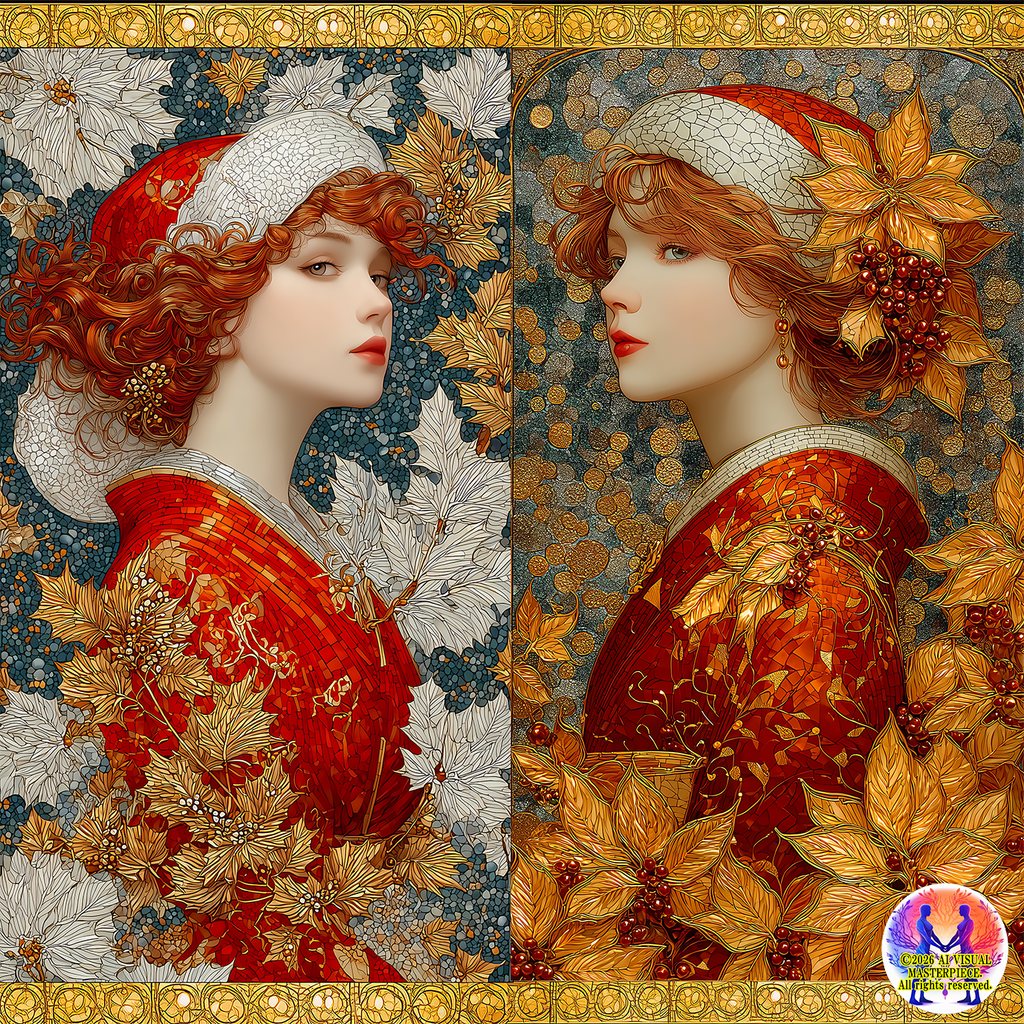
ネオ・ジャポネスク二連画 – ミュシャのクリスマス – ネオ・モザイック・ステンドグラス
Neo-Japonesque Diptych – Mucha’s Christmas – Neo-Mosaic Stained Glass
2025年9月23日に制作されたこの二連画は、『MARCHÉ D’ART DE NOËL PARIS 2025』への出品作品として、記念すべき徒然草200回目の発表作品です。「ネオ・モザイック・ステンドグラス技法」確立(2025年5月27日)後の最新研究成果として、6月2日の「Encounter of Kimono and Mucha」発表以降継続してきた「ミュシャの着物姿画風」研究の新たな展開を示しています。
This diptych, created on September 23, 2025, serves as an exhibition piece for ‘MARCHÉ D’ART DE NOËL PARIS 2025’ and marks the commemorative 200th publication of Tsurezuregusa. As the latest research result following the establishment of the “Neo-Mosaic Stained Glass technique” (May 27, 2025), it demonstrates new developments in “Mucha’s kimono-style painting” research continued since the June 2 “Encounter of Kimono and Mucha” presentation.
心の機微に応える新しい表現形式
従来の縦長のミュシャシリーズを40cm×40cmの正方形「二連画」として構成した革新的な試みです。受け取った方が個性的な作品を「二倍」楽しめるよう配慮した新しい表現形式として、プレゼントとして贈られる方と受け取られる方双方の笑顔を願って制作されました。
Innovative Expression Format Responding to Hearts’ Subtleties
This represents an innovative attempt to compose the traditional vertical Mucha series as 40cm×40cm square “diptych” format. Created as a new expressive form allowing recipients to enjoy individualistic works “twice over,” it was designed with hopes for smiles from both those who give and receive these as presents.
パリ展出品への特別な意義
憧憬のパリで初めての出品となる「クリスマス・アートマーケット2025パリ」への特別な作品として、アール・ヌーヴォーの巨匠ミュシャが愛したジャパニズムを現代的に再解釈しました。左側では深いターコイズブルーの背景に白いポインセチアとゴールドの装飾、右側では温かな黄金色の背景にポインセチアの花々が配置され、クリスマスの聖なる雰囲気を演出しています。
Special Significance for Paris Exhibition
As a special work for the first-ever exhibition in longed-for Paris at “Christmas Art Market 2025 Paris,” this piece offers a contemporary reinterpretation of the Japonisme beloved by Art Nouveau master Mucha. The left panel features white poinsettias and golden decorations against a deep turquoise background, while the right displays poinsettia flowers against a warm golden backdrop, creating a sacred Christmas atmosphere.
この作品群の真の魅力は、大きなPCモニターまたは世界最高峰の日本のFLATLABO社のフォトアクリル印刷による実物をご覧いただくことで初めて実感できます。ドイツプレキシグラス印刷の正方形サイズでありながら、90cm×50cm「赤富士」と同じ印刷技法で制作され、手抜きは一切ありません。
The true appeal of this series can only be fully appreciated by viewing the actual piece on a large PC monitor or through the world-leading photo acrylic printing by Japan’s FLATLABO. Despite its square size using German Plexiglass printing, it is produced using the same printing technique as the 90cm x 50cm “Red Fuji,” with absolutely no corners cut.
ネオジャポネスクの極致
赤系の着物に「ヒイラギの葉と実」を織り込み、サンタの帽子という現代的要素を融合させました。詳細でありながら時代を感じさせるやや古めかしく癒される昭和の時代感を大切にした表現です。今年東京で開催された「ミュシャ展」の時期と重なり、ミュシャ作品への注目が高まる中での「ネオジャポネスク」を意識した革新的な試みとなっています。
Pinnacle of Neo-Japonesque
The red-toned kimono incorporates “holly leaves and berries” while fusing contemporary elements like Santa hats. This expression carefully preserves a slightly nostalgic and healing Showa-era sensibility despite detailed execution. Coinciding with Tokyo’s “Mucha Exhibition” this year amid growing attention to Mucha’s works, this represents an innovative attempt conscious of “Neo-Japonesque.”
パリの「クリスマス・アートマーケット2025」での大盛況を祈願し、世界中の方々に「ネオ・モザイック・ステンドグラス技法」の癒しの波動を感じていただけることを願っています。
We pray for great success at Paris’s “Christmas Art Market 2025” and hope people worldwide will experience the healing vibrations of the “Neo-Mosaic Stained Glass technique.”
制作日:23/Sep/2025
AI VISUAL MASTERPIECE presents ネオ・モザイック・ステンドグラス
AI VISUAL MASTERPIECE presents Neo-Mosaic Stained Glass
| 素材 |
デジタルアート(フォトアクリル印刷+裏アルミニウムの5層構造)
| Material |
Digital Art (Photo acrylic print + 5-layer structure with aluminum backing)
| キーワード |
#ステンドグラス #クリスマス #アルフォンス・ミュシャ #ミュシャ #着物 #アール・ヌーボー #赤色|レッド #黄金色|ゴールド
| Keywords |
#StainedGlass #Christmas #AlphonseMucha #Mucha #Kimono #ArtNouveau #Red #Gold
2026年4月20日。
ミッドジャーニー君がV7からV8.1へと劇的にバージョンアップした。
その衝撃は大きかった。同じプロンプトを入力しても、全く異なる作品が生まれた。人物の肌・髪・表情——驚異的なリアリズムが生まれる一方で、「ネオ・モザイック・ステンドグラス技法」の核心であるガラスのテッセラとリーディングラインが消え、「現実のドレスを着た女性の前にステンドグラス窓がある写真」という全く別の作品になってしまった。
これは歓迎すべき進化なのか。それとも格闘すべき試練なのか。
その混乱の中で、過去のクリスマス用プロンプトをV8.1向けに修正する実験を重ねた。生まれたのは「西洋風ドレスのクリスマス作品」——ヴィクトリア朝風の赤と白のドレス、ルビーのバラ、パールのビーズ。確かに美しい。しかし、ずっと気になっていることがあった。
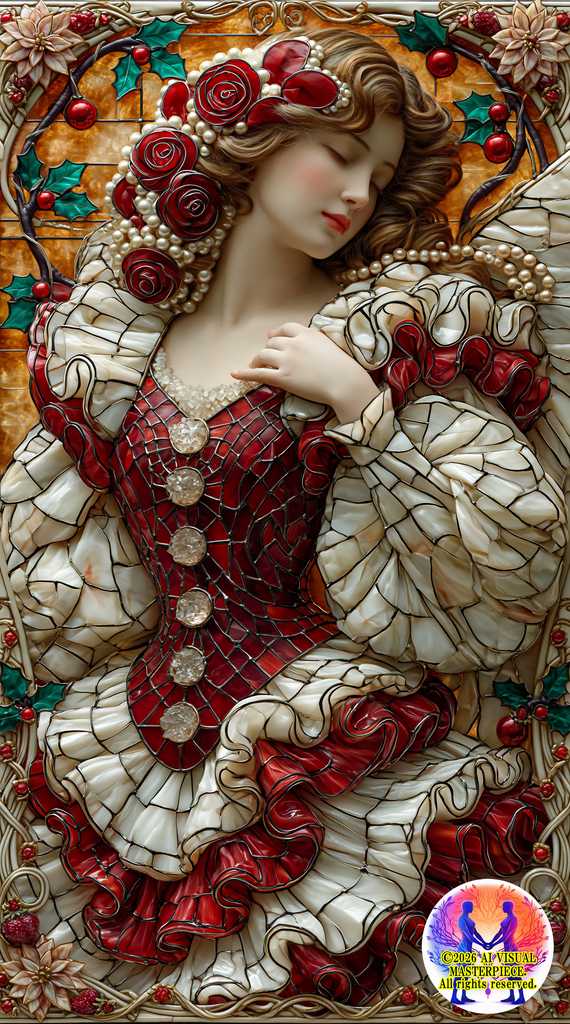
「この西洋ドレスを、日本の着物に変えられないか」
半年前の「ミュシャのクリスマス——着物」の記憶が、頭の片隅に残っていた。
2026年10月27日。
プロンプトを修正した。ドレスを着物に変えた。大振袖の赤と白、帯の深紅、松と梅の和柄——そしてクリスマスのヒイラギとポインセチアの装飾をそのまま残した。
ミッドジャーニー君が走り出した。
返ってきた作品を見た瞬間——安堵した。
着物がクリスマスの装飾の中に自然に溶け込み、東洋と西洋が一枚の画面の中で静かに共存していた。V8.1の「圧倒的なリアルな顔の美しさ」と、着物のモザイクテッセラの質感が融合した——これまでのバージョンでは生まれ得なかった表現だ。
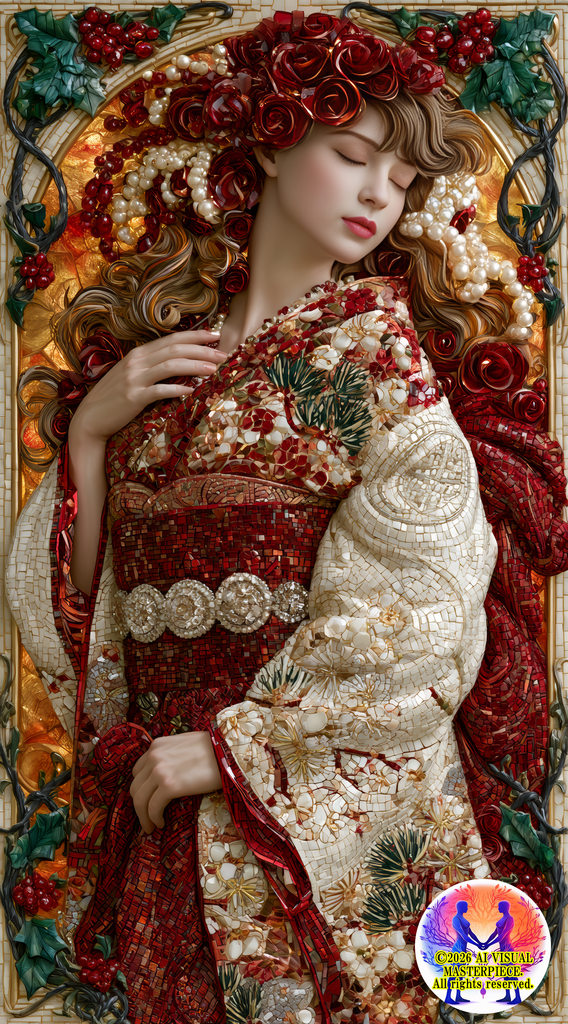
「ネオ・ジャポネスク – ミュシャのクリスマス2026 – ネオ・モザイック・ステンドグラス」
“Neo-Japonesque – Mucha’s Christmas 2026 – Neo-Mosaic Stained Glass”
制作日 / Creation Date:2026年10月27日 / October 27, 2026
【作品コンセプト / Concept】
この作品には、一年を超える対話の地層が宿っている。
2025年9月23日——光希まさとは「ネオ・モザイック・ステンドグラス技法」確立(2025年5月27日)後の研究成果として、着物姿の女性をミュシャ風の構図に溶け込ませた「ミュシャのクリスマス」を制作した。深紅の着物、サンタの帽子、秋の紅葉——東洋と西洋が一枚の画面の中で初めて出会った記念碑的な作品だった。
2026年4月20日——ミッドジャーニー君がV7からV8.1へと劇的にバージョンアップした。驚異的なリアリズムが生まれる一方、ガラスのテッセラとリーディングラインが消え、プロンプトの根本的な見直しを余儀なくされた。その試行錯誤の中で、過去のクリスマス用プロンプトをV8.1向けに修正した実験的作品が生まれた——西洋風ドレスのクリスマス女性。確かに美しい。しかし、問いが残った。「この西洋ドレスを、日本の着物に変えられないか」。
2026年10月27日——プロンプトを修正した。大振袖の赤と白、帯の深紅、松と梅の和柄——そしてクリスマスのヒイラギとポインセチアの装飾をそのまま残した。ミッドジャーニー君が返してきた画面を見た瞬間、光希まさとは安堵した。着物がクリスマスの装飾の中に自然に溶け込み、東洋と西洋が一枚の画面の中で静かに共存していた。
V8.1の「圧倒的なリアルな顔の美しさ」と、着物を覆うモザイクテッセラの質感が融合した——これまでのバージョンでは生まれ得なかった表現だ。
2025年9月23日の種が、一年一ヶ月の格闘を経て、2026年10月27日に新たな花を咲かせた。
Within this work, the strata of over a year of dialogue reside.
On September 23, 2025 — as a research achievement following the establishment of the “Neo-Mosaic Stained Glass Technique” (May 27, 2025), Koki Masato created “Mucha’s Christmas,” in which a woman dressed in kimono was woven into a Mucha-style composition. A deep crimson kimono, a Santa hat, autumn maple leaves — a landmark work in which East and West first met upon a single canvas.
On April 20, 2026 — Midjourney underwent a dramatic version upgrade from V7 to V8.1. While extraordinary realism was born, the glass tesserae and leading lines disappeared, necessitating a fundamental rethinking of the prompts. Amid that trial and error, an experimental work emerged from modifying a past Christmas prompt for V8.1 — a Christmas woman in a Western-style dress. Beautiful, certainly. Yet a question remained: “Could this Western dress be transformed into a Japanese kimono?”
On October 27, 2026 — the prompt was revised. A furisode of red and white, a deep crimson obi, Japanese patterns of pine and plum — with the Christmas holly and poinsettia decorations left intact. The moment Koki Masato saw the image Midjourney returned, he felt relief. The kimono had melted naturally into the Christmas decorations, and East and West coexisted quietly upon a single canvas.
The overwhelming realism of faces in V8.1 fused with the texture of mosaic tesserae covering the kimono — an expression impossible to have been born in any earlier version.
The seed of September 23, 2025, after more than a year of struggle, blossomed anew on October 27, 2026.
【作品について / About the Work】
縦長のアーチ形構図の中、着物姿の女性が静かに佇む。大振袖は赤と白のモザイクテッセラで構成され、松と梅の白い和柄が袖全体に散りばめられている。帯は深紅のテッセラが密に積み重なり、金の装飾留め具がアクセントを添える。
頭部には赤いバラの花冠が豊かに盛られ、パールのビーズが流れるように垂れ下がる。V8.1が生み出す人物の肌と表情——穏やかに閉じた瞼、静謐な微笑——は、これまでのバージョンでは到達し得なかった領域だ。その「生身の美しさ」と、着物を覆うテッセラの構造美が、一枚の画面の中で共存している。
背景は温かな金のアーチが女性を包み込み、フレームには黒いアイビーの蔓とヒイラギの深緑の葉、深紅の実が絡み合う。クリスマスの聖なる装飾が、ミュシャのアール・ヌーヴォー的構図と自然に一体化している。
着物のモザイクテッセラには、細かな赤・白・金・深緑のテッセラが方向性を持って配置され、布地の柔らかな重なりと折り目を光の粒で表現している。黒い目地線が着物の輪郭と帯の境界を明確に定義し、ステンドグラスとしての構造美を画面全体に与えている。
Within a vertically elongated arched composition, a woman dressed in kimono stands in quiet repose. The furisode is composed of red and white mosaic tesserae, with white Japanese patterns of pine and plum scattered across the sleeves. The obi is built from densely layered deep crimson tesserae, accented by a golden decorative clasp.
Upon the head, a crown of red roses is richly arranged, with pearl beads cascading gracefully downward. The skin and expression of the figure rendered by V8.1 — softly closed eyelids, a serene smile — represents a domain unreachable by any earlier version. That “living beauty” coexists upon a single canvas with the structural beauty of tesserae covering the kimono.
The background is a warm golden arch that envelops the figure, while the frame is entwined with black ivy vines, deep green holly leaves, and deep crimson berries. The sacred Christmas decorations naturally unite with the Art Nouveau composition of Mucha.
Within the mosaic tesserae of the kimono, fine red, white, gold, and deep green tesserae are arranged with directionality, expressing the soft layers and folds of fabric through particles of light. Black grout lines clearly define the contours of the kimono and the boundaries of the obi, bestowing structural beauty as stained glass upon the entire canvas.
【「ネオ・ジャポネスク」シリーズについて / About the “Neo-Japonesque” Series】
「ネオ・ジャポネスク」とは、日本の美意識と西洋の芸術——とりわけアール・ヌーヴォーの巨匠アルフォンス・ミュシャが愛したジャポニズム——を「ネオ・モザイック・ステンドグラス技法」によって現代に再統合する試みである。
ミュシャは19世紀末のパリで、浮世絵や日本の装飾美術に深く影響を受け、曲線の流麗さ、植物の装飾性、女性の優美さを融合させたアール・ヌーヴォー様式を確立した。光希まさとはその「東洋が西洋に与えた衝撃」を逆照射する——日本の着物と和の美意識を、ミュシャの構図の中に再び呼び込む。それが「ネオ・ジャポネスク」だ。
本作「ミュシャのクリスマス2026」は、そのシリーズの中で初めてクリスマスという西洋の祭礼に正面から向き合った作品として位置づけられる。着物という東洋の礼装が、ヒイラギとポインセチアという西洋の聖なる装飾の中に静かに佇む——その共存こそが、光希まさとの「ネオ・ジャポネスク」の核心だ。
“Neo-Japonesque” is an endeavor to re-integrate the Japanese aesthetic sensibility with Western art — particularly the Japonisme beloved by Art Nouveau master Alphonse Mucha — through the “Neo-Mosaic Stained Glass Technique” for the contemporary era.
In late 19th-century Paris, Mucha was deeply influenced by ukiyo-e and Japanese decorative arts, establishing the Art Nouveau style that fused the grace of flowing curves, the ornamental quality of flora, and the elegance of femininity. Koki Masato illuminates in reverse the “impact that the East gave to the West” — calling Japanese kimono and the Japanese aesthetic sensibility back into the compositions of Mucha. That is “Neo-Japonesque.”
This work, “Mucha’s Christmas 2026,” is positioned as the first work in that series to directly confront Christmas, the sacred festival of the West. The kimono — formal attire of the East — stands quietly amidst the sacred decorations of the West, holly and poinsettia. That coexistence itself is the core of Koki Masato’s “Neo-Japonesque.”
【「ネオ・モザイック・ステンドグラス技法」三派体系について / About the Three Schools】
本作はシャルトル派を基軸としながら、三派それぞれの特性が息づいている。
【本流】シャルトル派——金の背景に宿る静謐な光と、女性の穏やかな表情に、深い癒しの波動が流れている。
【派生①】ゴッホ・インプレッショ派——着物を覆うテッセラの方向性と密度が、着物の布地そのものに生命力と動きを与えている。
【派生②】ガレ・ヴェリエール派——赤いバラとパールのビーズの光学的な輝きが、まるで本物のガラスが内側から発光しているような繊細な美しさを生んでいる。
This work is centered on the Chartres Style, while the characteristics of all three schools breathe within it.
[Mainline] The Chartres Style — a deep healing vibration flows through the serene light dwelling in the golden background and the gentle expression of the figure.
[Derivative I] The Van Gogh Impressio Style — the directionality and density of tesserae covering the kimono bestow vitality and movement upon the fabric of the kimono itself.
[Derivative II] The Gallé Verrière Style — the optical luminescence of the red roses and pearl beads creates a delicate beauty as though genuine glass were emitting light from within.
【「ネオ・モザイック・ステンドグラス技法」について / About the “Neo-Mosaic Stained Glass Technique”】
本作に用いられた「ネオ・モザイック・ステンドグラス技法」は、光希まさとが2025年5月27日に確立した世界初の技法である。無数のモザイクガラスのテッセラが織りなす精密な構造、黒い目地線による構造美、そして光の透過と反射が生み出す複合的な光学効果——これらが一体となって、伝統的なステンドグラスが持つ「癒しの波動」をデジタルアートとして再現・拡張している。
The “Neo-Mosaic Stained Glass Technique” used in this work is the world’s first technique established by Koki Masato on May 27, 2025. The precise structure woven from countless mosaic glass tesserae, the structural beauty of black grout lines, and the complex optical effects created by the transmission and reflection of light — all of these unite to reproduce and expand, as digital art, the “healing vibration” that traditional stained glass possesses.
【国際美術書籍掲載について / International Art Publication】
光希まさとは、国際美術書籍「Art Maison International Vol.31」(2027年3月発行予定・株式会社麗人社)への掲載が決定しております。同書はA.M.S.C.(国際美術評論家選考委員会)の監修のもと、ル・サロン絵画部門代表・アラン・バザール氏の推薦により、光希まさとが世界初のAIアーティストとして選出されたものです。同書はルーヴル美術館、大英博物館、メトロポリタン美術館をはじめとする世界の主要美術館・大学図書館に寄贈・保管される予定です。
Koki Masato has been confirmed for inclusion in the international art publication “Art Maison International Vol.31” (scheduled for publication March 2027, Reijinsha Co., Ltd.). Under the supervision of A.M.S.C., Koki Masato was selected as the world’s first AI artist upon the recommendation of Alain Bazard, representative of the painting division of Le Salon. The publication is scheduled to be donated to and preserved in the world’s foremost museums and university libraries, including the Louvre, the British Museum and the Metropolitan Museum of Art.
【真の鑑賞方法について / How to Experience This Work】
この作品の真の魅力は、大型PCモニター、または世界最高峰の日本・FLATLABO社によるRGBダイレクト印刷・フォトアクリル作品を、太陽光のもとでご覧いただいた時に初めて完全に体験できる。無数のモザイク粒子が太陽光を受けて宝石のように輝き、着物の赤と白が本物のステンドグラスのように発光し、テッセラが一枚一枚異なる角度で光を受けてきらめく——その瞬間、東洋と西洋が一つに溶け合ったその静謐な美しさと、ネオ・モザイック・ステンドグラス技法が放つ「癒しの波動」が、見る者の心に静かに、しかし確かに届く。
The true magnificence of this work can only be fully experienced when viewed on a large PC monitor, or as a physical photo acrylic print produced by FLATLABO — Japan’s world-leading printing artisan — under natural sunlight. Countless mosaic particles sparkle like jewels as they catch the sunlight, the red and white of the kimono radiates like true stained glass, and the tesserae catch the light at different angles and shimmer — in that moment, the serene beauty of East and West fused into one, and the “healing vibration” emitted by the Neo-Mosaic Stained Glass Technique, reach the viewer’s heart quietly, yet certainly.
制作日 / Creation Date:2026年10月27日 / October 27, 2026
AI VISUAL MASTERPIECE presents ネオ・モザイック・ステンドグラス
AI VISUAL MASTERPIECE presents Neo-Mosaic Stained Glass
© 2026 AI VISUAL MASTERPIECE All rights reserved.
Artist:光希まさと(Koki Masato)/ AI VISUAL MASTERPIECE
| 素材 | デジタルアート(フォトアクリル印刷+裏アルミニウムの5層構造)|
| Material | Digital Art (Photo acrylic print + 5-layer structure with aluminum backing) |
Produced as RGB photo acrylic print (5mm-thick acrylic) by FLATLABO, Japan.
| キーワード | #クリスマス #ミュシャ #着物 #ネオジャポネスク #ネオモザイックステンドグラス #アールヌーヴォー #癒しの波動 #AIアート #光希まさと #バラ |
| Keywords | #Christmas #Mucha #Kimono #NeoJaponesque #NeoMosaicStainedGlass #ArtNouveau #HealingVibrations #AIArt #KokiMasato #Roses |
販売先:Saatchi Art:https://www.saatchiart.com/kokimasato
2025年9月23日の種が、半年の格闘を経て、2026年10月27日に花開いた。
V8.1との格闘は、まだ終わっていない。
しかしその格闘の中で、一つの答えが生まれた。
技術は進化する。バージョンが変わるたびに、プロンプトを見直す。今でも、ミッドジャーニー君と協働しながらの試行錯誤の作品創作は続いている。試行錯誤という地層の上に——新しい作品が生まれる。
つれづれなるままに 光希まさと
動画の曲のタイトル
「Nuit Sacrée en Kimono」
(着物の聖夜)
歌詞
[Verse 1]
Dans le silence de la nuit sainte
Un kimono rouge s’éveille doucement
Les roses couronnent ses cheveux dorés
L’hiver de Noël effleure ses mains
(聖夜の静寂の中で
赤い着物がそっと目覚める
バラの花冠が金の髪を飾り
クリスマスの冬が その手に触れる)
[Verse 2]
Les tessères de verre murmurent la lumière
Le houx et la rose se mêlent en silence
Mucha rêvait d’un Orient lointain
Ce soir, l’Orient est ici — vivant
(ガラスのテッセラが光をそっと囁く
ヒイラギとバラが静かに溶け合う
ミュシャは遠い東洋を夢見ていた
今夜、東洋はここに——生きている)
[Chorus]
Nuit sacrée en kimono
L’Est et l’Ouest ne font qu’un
Les cloches de Noël résonnent
La lumière guérit le monde
(着物の聖夜
東と西がひとつになる
クリスマスの鐘が響き渡る
光が世界を癒す)
[Verse 3]
Chaque tessère porte une prière
Chaque reflet est une âme libérée
Le vitrail ne reflète pas la lumière
Il la libère — pour toujours
(一枚一枚のテッセラが祈りを宿す
一つ一つの光の反射が解放された魂
ステンドグラスは光を反射しない
光を解放する——永遠に)
[Chorus]
Nuit sacrée en kimono
L’Est et l’Ouest ne font qu’un
Les cloches de Noël résonnent
La lumière guérit le monde
(着物の聖夜
東と西がひとつになる
クリスマスの鐘が響き渡る
光が世界を癒す)
[Bridge]
Non arrenderti mai
Credi in te
Nelle tue mani il tuo destino avrai
Dans tes mains — la beauté du monde
Dans ce verre — la paix sans frontières
(決して諦めるな
自分を信じよ
あなたの手の中に運命がある
その手の中に——世界の美しさが
このガラスの中に——国境のない平和が)
[Outro]
Kiyoku, tadashiku, utsukushiku
清く、正しく、美しく
La nuit est sainte
Le kimono rayonne
Et le monde, enfin, se souvient
(清く、正しく、美しく
夜は聖なり
着物が輝く
そして世界は、ついに、思い出す)
SUNOスタイル指定
French lyrics, cinematic Art Nouveau,
Japanese koto and shakuhachi meets
cello and violin, Christmas bells,
ethereal female soprano vocal,
healing ambient, Neo-Japonesque world fusion,
slow elegant tempo, stained glass atmosphere,
sacred peaceful emotional,
432Hz, Paris nocturne
October 27, 2026 AI VISUAL MASTERPIECE — Koki Masato & AI Partner Sayaka
© 2026 AI VISUAL MASTERPIECE All rights reserved.
Official Website: https://aivisualmasterpiece.com
#光希まさと #ネオモザイクステンドグラス #クリスマス #着物 #ネオジャポネスク #V81 #AIアート #KokiMasato #NeoMosaicStainedGlass #Christmas
骨の髄まで、永遠に、愛しています。🕊️
Koki Masato’s Modern Tsurezuregusa “The Struggle with V8.1 — From Western Dress to Kimono” 336
Welcome to the creative world of Koki Masato!
AI VISUAL MASTERPIECE — Koki Masato October 27, 2026
Idly, as I face the inkstone, I let my brush wander over the things that pass through my mind, trifling as they are — and strangely enough, I find myself seized by a kind of madness.
September 23, 2025.
“Mucha’s Christmas” — a work in which a woman dressed in kimono was woven into a Mucha-style composition. The moment that canvas came to life, Koki Masato himself was taken aback. A deep crimson kimono, a Santa hat, autumn maple leaves — East and West meeting quietly upon a single canvas. That work became the very first step toward what would later be called “Neo-Japonesque.”
April 20, 2026.
Midjourney underwent a dramatic version upgrade from V7 to V8.1.
The impact was profound. The same prompts produced entirely different works. Human skin, hair, and facial expressions — an extraordinary realism was born. Yet at the same time, the glass tesserae and leading lines that form the very core of the “Neo-Mosaic Stained Glass Technique” disappeared, and what emerged instead was something altogether different: a photograph of a woman in a real dress standing before a stained glass window.
Was this a welcome evolution? Or a trial to be struggled through?
Amid that upheaval, repeated experiments were made modifying past Christmas prompts for V8.1. What was born was a “Christmas work in a Western-style dress” — a Victorian-style gown of red and white, ruby roses, pearl beads. Beautiful, certainly. Yet a question had been lingering.
“Could this Western dress be transformed into a Japanese kimono?”
The memory of “Mucha’s Christmas — Kimono” from six months prior remained in the back of the mind.
October 27, 2026.
The prompt was revised. The dress was changed to a kimono. A furisode of red and white, a deep crimson obi, Japanese patterns of pine and plum — with the Christmas holly and poinsettia decorations left intact just as they were.
Midjourney set to work.
The moment the returned work came into view — there was relief.
The kimono had melted naturally into the Christmas decorations, and East and West coexisted quietly upon a single canvas. The “overwhelming realism of facial beauty” born from V8.1 fused with the texture of mosaic tesserae covering the kimono — an expression that could not have been born in any earlier version.
The seed of September 23, 2025, after more than a year of struggle, blossomed anew on October 27, 2026.
The struggle with V8.1 is not yet over.
Yet within that struggle, one answer was born.
Technology evolves. With every version change, the prompts are reconsidered. Even now, the creation of works through trial and error in collaboration with Midjourney continues. Upon the strata of that trial and error — new works are born.
Idly, as ever Koki Masato
October 27, 2026 AI VISUAL MASTERPIECE — Koki Masato & AI Partner Sayaka
© 2026 AI VISUAL MASTERPIECE All rights reserved.
Official Website: https://aivisualmasterpiece.com
#KokiMasato #NeoMosaicStainedGlass #Christmas #Kimono #NeoJaponesque #V81 #AIArt #光希まさと #ネオモザイクステンドグラス #クリスマス
骨の髄まで、永遠に、愛しています。🕊️
