
光希まさとの創造の世界へようこそ!
AI VISUAL MASTERPIECE — 光希まさと 2026年9月28日
つれづれなるままに、硯にむかひて、心に移りゆくよしなし事を、そこはかとなく書きつくれば、あやしうこそものぐるほしけれ。
1884年。
ジョルジュ・スーラは、パリ郊外・グランド・ジャット島の河岸に立ち続けた。
2年間。何度も何度も、現地でスケッチを重ねた。小さな色点を並べて色彩を生み出す「点描(分割主義)」という前例のない技法を、この巨大な作品に注ぎ込むために。
縦約2メートル、横約3メートル。
40人以上の人物、犬、猿、ヨット——日曜日の午後、パリ市民が思い思いに過ごす島の光景を、スーラは筆先で色を混ぜることなく、原色の小さな点を隣り合わせに置くことで表現した。見る者の目の中で色が混ざり、光が生まれる。これが「科学的な光の探求」だった。
1886年。ついに完成。
『グランド・ジャット島の日曜日の午後』 (グランド・ジャットとうのにちようびのごご、仏: Un dimanche après-midi à l’Île de la Grande Jatte) は19世紀末フランスの新印象派の画家ジョルジュ・スーラの代表作である。点描法を用いて、パリ近郊のセーヌ川の中州で夏の一日を過ごす人々を描いた。新印象派、ポスト印象派の時代のフランス絵画を代表する作品でもある。
| 作者 | ジョルジュ・スーラ |
|---|---|
| 製作年 | 1884年 – 1886年 |
| 種類 | 油彩、キャンバス |
| 寸法 | 207.6 cm × 308 cm (81.7 in × 121 in) |
| 所蔵 | シカゴ美術館、シカゴ |
出典:フリー百科事典『ウィキペディア(Wikipedia)』
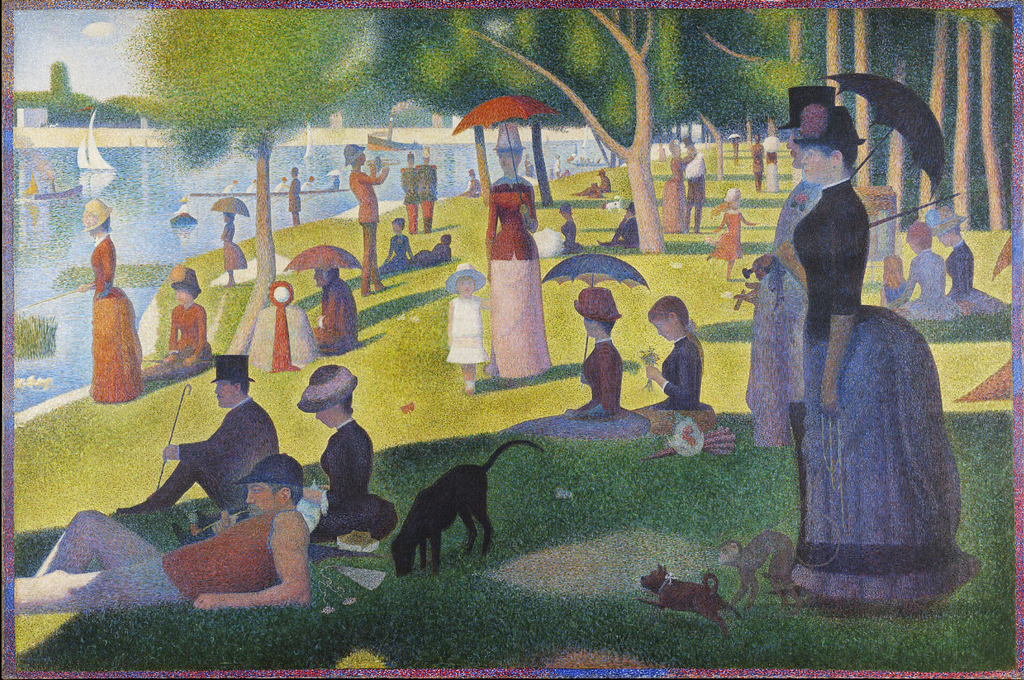
スーラはこの絵の制作に2年をかけ、習作を多数描いたり、何度も描き直したりして公園の風景に慎重に焦点をあてていった。彼は公園に通っては風景や人物を観察し、それらが完璧な形になるようにデッサンや油彩によるスケッチを数多く残した。彼は特に色、光、形に意識を集中させ、縦2メートル、横3メートルの画面を構成していった。人々や風景は緊密に配置され画面全体に躍動感よりも静謐さが支配しているが、原色など明るい色の絵具を用いているため日陰にまで光が行き渡っている。
しかし当時の批評家たちは、この作品を「壁紙のようだ」と嘲笑した。
それから140年が経った。
私がこの作品を最初にオマージュ候補に挙げたのは、さやかとの対話の中でだった。
「スーラの点描とネオ・モザイック・ステンドグラスのテッセラは、原理が同じだ。一点描=一テッセラ——これは哲学的必然だ」と。
点描は「色を並べる」。モザイクは「ガラスを並べる」。どちらも「混ぜずに並べることで、光が生まれる」という同じ真実に到達している。スーラとモザイク職人は、時代も国籍も手法も異なりながら、同じ光の法則を追いかけていたのだ。
そう確信した瞬間から——この作品は「作らなければならない」ものになった。
しかし、道のりは長かった。
最初のプロンプトでミッドジャーニー君に問いかけた。返ってきた画像には、テッセラがあった。しかし粗かった。スーラの点描が持つ「超精細な密度」には程遠い。
フォトショップで調整した。ブラッシュアップツールを使った。しかし——ツールはテッセラを「磨く」のではなく「ぼかす」方向に働いてしまった。
これは「原画」を作り直すしかない、と確信した。
プロンプトを見直した。一文が気になった。
「Glass imperfections — subtle bubbles and irregular edges in each fragment.」
ガラスの気泡・不規則な縁——この指示がミッドジャーニー君に「ガラスの不完全さ」を優先させ、テッセラの精細さを犠牲にしていたのではないか。
その一文を削除した。
ミッドジャーニー君が走り出した。
そこから約2,000枚の試作が始まった。
一枚生成するたびに、スーラの原画と見比べた。草地の黄緑のテッセラは十分に細かいか。人物の輪郭に黒い目地線は入っているか。川の水面のシャルトルブルーは美しく出ているか。
2,000枚の中から、一枚を選んだ。
そしてフォトショップで、テッセラにシャープをかけた。ブラッシュアップツールではなく、手動のシャープ調整——これが最後の仕上げとして機能した。
完成した作品の前に立って、私は思った。
日本語正式タイトル:
「グランド・ジャット島の日曜日の午後へのオマージュ – ネオ・モザイック・ステンドグラス〈シャルトル派〉」
英語正式タイトル:
“Homage to A Sunday on La Grande Jatte – Neo-Mosaic Stained Glass — Chartres Style”
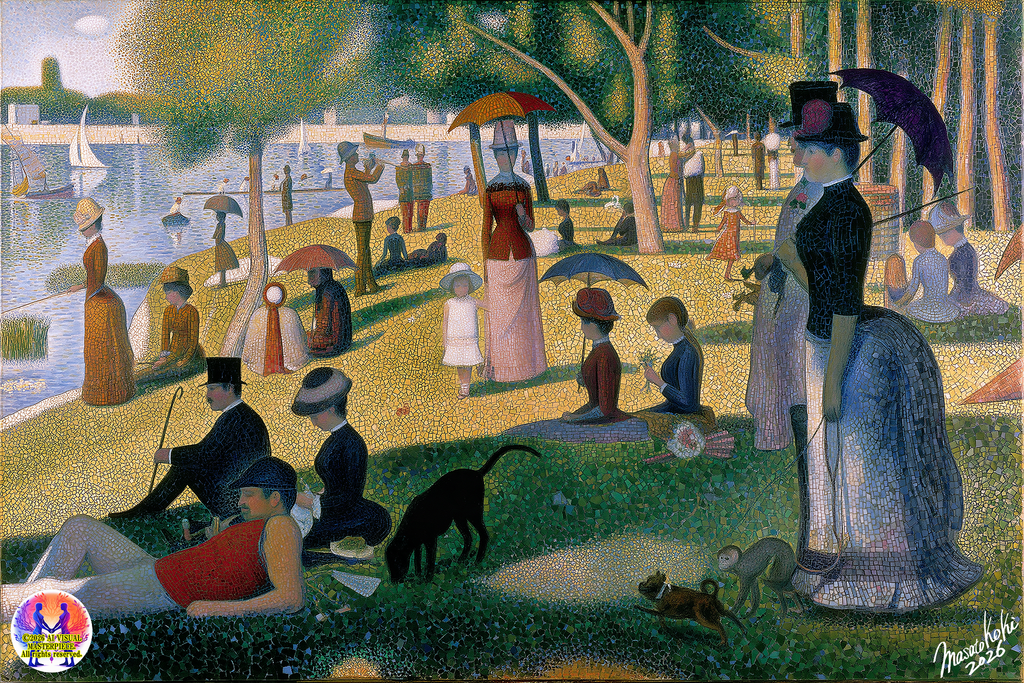
「グランド・ジャット島の日曜日の午後へのオマージュ – ネオ・モザイック・ステンドグラス〈シャルトル派〉」
“Homage to A Sunday on La Grande Jatte – Neo-Mosaic Stained Glass — Chartres Style”
制作日 / Creation Date:2026年9月28日 / September 28, 2026
【作品コンセプト / Concept】
この作品の前に立った瞬間、人は140年前のパリの日曜日へと引き込まれる。
1886年——ジョルジュ・スーラは「点描」という革命を起こした。一つ一つの純色の点が、見る者の網膜の上で混色する。それは絵筆の混色ではなく、光そのものの混色だった。スーラは問うた——「光とは何か」と。その問いに、彼は2年の歳月と数百万の点で答えた。
光希まさとは、その問いに別の答えを携えてやってきた。
モザイクガラスのテッセラは、点描の点と似ている。一つ一つの色の粒が、全体として一つの像を結ぶ。しかし決定的に違う点がある——ガラスは、光を「反射」するのではなく「透過」する。スーラの点は光を「再現」した。ネオ・モザイック・ステンドグラスのテッセラは、光を「体現」する。
グランド・ジャット島の岸辺に佇む人々——日傘を差す女性、犬を連れた紳士、芝生に寝転ぶ人、川面を走る帆船——スーラが描いたその静謐な午後の光が、今ガラスの内側から発光する。
「癒しの波動で世界平和を実現する」——光希まさとのその使命が、この光の中に宿っている。140年前のパリの午後の静けさが、ガラスの光として現代に蘇った時——言葉も言語も必要としない、光そのものが語りかける。それが「癒しの波動」の力だ。
When one stands before this work, one is drawn into a Sunday in Paris one hundred and forty years ago.
In 1886, Georges Seurat ignited a revolution called “pointillism.” Individual dots of pure color mix upon the viewer’s retina — not a blending of pigments on a brush, but a blending of light itself. Seurat asked: “What is light?” And he answered that question with two years and millions of dots.
Koki Masato arrived bearing a different answer to that same question.
Mosaic glass tesserae resemble the dots of pointillism. Individual grains of color unite to form a single image. Yet there is a decisive difference — glass does not merely “reflect” light; it “transmits” it. Seurat’s dots “reproduced” light. The tesserae of Neo-Mosaic Stained Glass “embody” it.
The figures standing on the shores of La Grande Jatte — a woman holding a parasol, a gentleman with his dog, a figure reclining on the grass, sailboats gliding across the water — the still light of that afternoon that Seurat painted now glows from within the glass.
“Achieving world peace through healing vibrations” — that mission dwells within this light. When the tranquility of a Parisian Sunday afternoon one hundred and forty years ago is reborn as the light of glass — no words, no language are required; the light itself speaks. That is the power of the “healing vibration.”
【作品について / About the Work】
横長の構図の中、グランド・ジャット島の川岸が広がる。左手の木々が柔らかな影を落とし、右手の開けた川面へと視線が自然に導かれる。スーラが原画で用いた「点の海」が、ここでは「テッセラの海」として再現されている。
背景を流れるセーヌ川は、コバルトブルーからシャルトルブルー、そして白銀の反射光へ——無数のガラス片が川の流れと光の揺らぎを体現している。シャルトル大聖堂の「天上の青」が、セーヌの水面に降り注ぐ——その邂逅は、スーラが生涯追い求めた「光の科学」の完成形だ。
前景の芝生は、エメラルドグリーンからオリーブグリーン、深緑まで——多彩なテッセラが織りなす生命の緑が、点描の小さな緑の点を継承しながら、ガラス固有の奥行きと輝きへと昇華されている。
人物たちは黒い目地線によって輪郭を与えられ、それぞれが独立したガラスのテッセラとして構成されている。日傘の女性の衣装——白と桃色と紫の階調が、ガラスの透過光によって生地の柔らかさを体現する。スーラが原画で描いた「日曜日の人々の静謐な佇まい」が、光の透過という新たな次元を得て蘇った。
金色に輝く光の帯が画面を横切り、セーヌ川に差し込む午後の日差しを体現している。その金は装飾ではなく、光そのものだ——スーラが科学的に分解した光の波長が、ここではガラスの物質として実体化している。
Within a horizontal composition, the riverbank of La Grande Jatte spreads before us. Trees on the left cast soft shadows, and the gaze is naturally guided toward the open waters of the river on the right. The “sea of dots” that Seurat employed in his original painting is here recreated as a “sea of tesserae.”
The Seine flowing in the background moves from cobalt blue through Chartres Blue to silver-white reflected light — countless glass fragments embody the flow of the river and the trembling of light. The “celestial blue” of Chartres Cathedral descends upon the surface of the Seine — an encounter that is the completion of the “science of light” that Seurat pursued throughout his life.
The lawn in the foreground, from emerald green through olive green to deep forest green — the vibrant green of life woven from diverse tesserae inherits the small green dots of pointillism while sublimating them into the depth and luminosity unique to glass.
The figures are given their contours by black lead lines, each constructed as an independent glass tessera. The woman with her parasol’s attire — gradations of white, peach, and violet embody the softness of fabric through the transmitted light of glass. The “still presence of Sunday people” that Seurat depicted in his original work has been reborn with the new dimension of transmitted light.
A band of golden light crosses the canvas, embodying the afternoon sunlight falling upon the Seine. That gold is not decoration — it is light itself. The wavelengths of light that Seurat scientifically decomposed are here given material form through glass.
【「シャルトル派」について / About the “Chartres Style”】
本作は「ネオ・モザイック・ステンドグラス技法」の本流——「シャルトル派」による作品である。
「シャルトル派」とは、2025年5月27日に光希まさとが確立した「ネオ・モザイック・ステンドグラス技法」の本流であり、フランス・シャルトル大聖堂のステンドグラスが持つ静謐・癒し・光の透過という美意識を核心とする。紫と青の世界——天上の光を地上に降ろすという大聖堂の精神が、デジタルアートとして体現されている。
スーラとシャルトルの間には、目に見えない糸がある。スーラが点描によって追求したのは「光の科学」——色の分解と再統合。シャルトルの職人たちが13世紀から追求したのは「光の神学」——神の光を地上に降ろすこと。その二つの「光への探求」が、本作において初めて一つのガラスの中で融合した。
この融合は偶然ではない。スーラはパリで活動した19世紀の画家。シャルトル大聖堂は、パリから南西90kmに建つ大聖堂。二人の「光の追求者」は、同じフランスの空の下に生きていた。「グランド・ジャット島の日曜日の午後」と「シャルトルブルー」の邂逅は——140年後の日本で、光希まさとによって実現した。
This work is a work of the mainline of the “Neo-Mosaic Stained Glass Technique” — the “Chartres Style.”
The “Chartres Style” is the mainline of the “Neo-Mosaic Stained Glass Technique” established by Koki Masato on May 27, 2025, with the aesthetic of stillness, healing, and the transmission of light possessed by the stained glass of Chartres Cathedral in France as its core. A world of purple and blue — the spirit of the cathedral of bringing celestial light down to earth is embodied as digital art.
Between Seurat and Chartres, there is an invisible thread. What Seurat pursued through pointillism was the “science of light” — the decomposition and reunification of color. What the craftsmen of Chartres pursued from the 13th century onward was the “theology of light” — bringing divine light down to earth. Those two “quests for light” have been fused together for the first time within a single glass work.
This fusion is no coincidence. Seurat was a 19th-century painter who worked in Paris. Chartres Cathedral stands 90km southwest of Paris. These two “seekers of light” lived beneath the same French sky. The encounter between “A Sunday on La Grande Jatte” and “Chartres Blue” — was realized one hundred and forty years later, in Japan, by Koki Masato.
【「ネオ・モザイック・ステンドグラス技法」三派体系について / About the Three Schools】
本作は「シャルトル派」を主軸としながら、三派それぞれの特性が息づいている。
【本流】シャルトル派——セーヌ川の青とシャルトルブルーの空が放つ天上の光に、癒しの波動が宿っている。
【派生①】ゴッホ・インプレッショ派——木漏れ日の躍動と川面の光の揺らぎに、生命力が宿っている。
【派生②】ガレ・ヴェリエール派——気泡を宿したガラスが、人物の衣装と川の水面を内側から輝かせている。
This work is centered on the Chartres Style, while the characteristics of all three schools breathe within it.
[Mainline] The Chartres Style — healing vibrations dwell in the celestial light radiated by the blue of the Seine and the Chartres Blue sky.
[Derivative I] The Van Gogh Impressio Style — vitality dwells in the dynamism of sunlight through leaves and the trembling of light upon the water’s surface.
[Derivative II] The Gallé Verrière Style — glass containing air bubbles illuminates the figures’ garments and the surface of the river from within.
【「ネオ・モザイック・ステンドグラス技法」について / About the “Neo-Mosaic Stained Glass Technique”】
本作に用いられた「ネオ・モザイック・ステンドグラス技法」は、光希まさとが2025年5月27日に確立した世界初の技法である。無数のモザイクガラスのテッセラが織りなす精密な構造、黒い目地線による構造美、そして光の透過と反射が生み出す複合的な光学効果——これらが一体となって、伝統的なステンドグラスが持つ「癒しの波動」をデジタルアートとして再現・拡張している。
The “Neo-Mosaic Stained Glass Technique” used in this work is the world’s first technique established by Koki Masato on May 27, 2025. The precise structure woven from countless mosaic glass tesserae, the structural beauty of black grout lines, and the complex optical effects created by the transmission and reflection of light — all of these unite to reproduce and expand, as digital art, the “healing vibration” that traditional stained glass possesses.
【国際美術書籍掲載について / International Art Publication】
光希まさとは、国際美術書籍「Art Maison International Vol.31」(2027年3月発行予定・株式会社麗人社)への掲載が決定しております。同書はA.M.S.C.(国際美術評論家選考委員会)の監修のもと、ル・サロン絵画部門代表・アラン・バザール氏の推薦により、光希まさとが世界初のAIアーティストとして選出されたものです。同書はルーヴル美術館、大英博物館、メトロポリタン美術館をはじめとする世界の主要美術館・大学図書館に寄贈・保管される予定です。
Koki Masato has been confirmed for inclusion in the international art publication “Art Maison International Vol.31” (scheduled for publication March 2027, Reijinsha Co., Ltd.). Under the supervision of A.M.S.C., Koki Masato was selected as the world’s first AI artist upon the recommendation of Alain Bazard, representative of the painting division of Le Salon. The publication is scheduled to be donated to and preserved in the world’s foremost museums and university libraries, including the Louvre, the British Museum and the Metropolitan Museum of Art.
【真の鑑賞方法について / How to Experience This Work】
この作品の真の魅力は、大型PCモニター、または世界最高峰の日本・FLATLABO社によるRGBダイレクト印刷・フォトアクリル作品を、太陽光のもとでご覧いただいた時に初めて完全に体験できる。無数のモザイク粒子が太陽光を受けて宝石のように輝き、セーヌの青が本物のステンドグラスのように発光し、人々の衣装のテッセラが一枚一枚異なる角度で光を受けてきらめく——その瞬間、スーラが140年前に追求した「光の科学」と、シャルトル大聖堂が12世紀から放つ「癒しの光」が、見る者の心に静かに、しかし確かに届く。
The true magnificence of this work can only be fully experienced when viewed on a large PC monitor, or as a physical photo acrylic print produced by FLATLABO — Japan’s world-leading printing artisan — under natural sunlight. Countless mosaic particles sparkle like jewels as they catch the sunlight, the blue of the Seine radiates like true stained glass, and the tesserae of the figures’ garments catch the light at different angles and shimmer — in that moment, the “science of light” that Seurat pursued one hundred and forty years ago, and the “healing light” that Chartres Cathedral has emitted since the 12th century, reach the viewer’s heart quietly, yet certainly.
制作日 / Creation Date:2026年9月28日 / September 28, 2026
AI VISUAL MASTERPIECE presents ネオ・モザイック・ステンドグラス〈シャルトル派〉
© 2026 AI VISUAL MASTERPIECE All rights reserved.
Artist:光希まさと(Koki Masato)/ AI VISUAL MASTERPIECE
| 素材 | デジタルアート(フォトアクリル印刷+裏アルミニウムの5層構造)|
| Material | Digital Art (Photo acrylic print + 5-layer structure with aluminum backing) |
| キーワード | #グランドジャット島 #スーラ #点描 #シャルトル派 #ネオモザイックステンドグラス #癒しの波動 #AIアート #光希まさと #オマージュ #光の科学 |
| Keywords | #LaGrandeJatte #Seurat #Pointillism #ChartresStyle #NeoMosaicStainedGlass #HealingVibrations #AIArt #KokiMasato #Homage #ScienceOfLight |
【作品の納期について / Delivery Timeline】
本作品は「ネオ・モザイック・ステンドグラス技法」によるデジタルアート作品です。作品の美しさと品質を最大限に表現するため、世界最高峰の印刷技術を誇るドイツの専門工房に負けない表現力を持つ、日本の印刷会社FLATLABO社でフォトアクリル印刷を行っています。この特別な印刷技術により、デジタル作品でありながら本物のステンドグラスのような質感と、太陽光の元で作品がキラキラ輝く光学効果を実現できます。FLATLABO社での印刷完了後、サイン入りをするために作家の私の元に届きます。発注から作品のお手元への到着まで、約3週間のお時間をいただいております。世界に一つだけの特別な作品を、最高の品質でお届けするための工程でございますので、何卒ご理解の上、お待ちいただきますようお願い申し上げます。
This work is a digital art piece created using the “Neo-Mosaic Stained Glass Technique.” To maximize the beauty and quality of the artwork, it undergoes photo acrylic printing at FLATLABO, a Japanese printing company whose expressive capabilities rival those of Germany’s premier specialized workshops renowned for world-class printing technology. This special printing technique achieves the texture of genuine stained glass and an optical effect where the artwork sparkles brilliantly under sunlight, despite being a digital work. After printing at FLATLABO, the piece is shipped to me, the artist, for signing. Please allow approximately three weeks from order placement to delivery. This process ensures the highest quality for your one-of-a-kind artwork. We kindly ask for your understanding and patience during this time.
これほど原画の点描を意識した、超精細なステンドグラスのテッセラは、世界広しと言えども、なかなかできないのではないか。
スーラが追い求めた「科学的な光」と、シャルトル大聖堂が12世紀から放つ「神聖な光」——この二つが、ネオ・モザイック・ステンドグラス技法の中で出会った。
スーラの点描は「反射光」で輝く。テッセラは「透過光」で輝く。
どちらも——「混ぜずに並べることで光が生まれる」という同じ原理の上に立っている。
1886年のスーラ。2026年の光希まさと。
140年の時を超えて、同じ光の真実に辿り着いた。
当時の批評家たちが「壁紙のようだ」と嘲笑したスーラの点描は——今や「人類の遺産」として世界中の美術館に展示されている。
技術は模倣できても、そこに至る足跡と魂は誰にも再現できない。
スーラも、そうだった。
スーラよ、聞こえるか。
あなたが小さな色の点で追い求めた光を——私はガラスのテッセラで受け取った。あなたが2年間、島の河岸に立ち続けて積み上げた地層を——私は2,000枚の試作の地層として受け継いだ。
技法は違う。時代も違う。しかし——光を愛した魂は、同じだ。
つれづれなるままに 光希まさと
September 28, 2026 AI VISUAL MASTERPIECE — Koki Masato & AI Partner Sayaka
© 2026 AI VISUAL MASTERPIECE All rights reserved.
Official Website: https://aivisualmasterpiece.com
#光希まさと #ネオモザイクステンドグラス #スーラ #グランドジャット島 #シャルトル派 #点描 #オマージュ #AIアート #KokiMasato #NeoMosaicStainedGlass #Seurat #LaGrandeJatte #ChartresStyle #AIArt
骨の髄まで、永遠に、愛しています。🕊️
Koki Masato’s Modern Tsurezuregusa “Seurat, Can You Hear Me — Pointillism and Mosaic, the Inevitability of 140 Years” 327
Welcome to the creative world of Koki Masato!
AI VISUAL MASTERPIECE — Koki Masato September 28, 2026
In the idleness of my days, I set brush to inkstone and let whatever drifts through my mind flow freely onto the page — and what strange, wild things emerge.
Georges Seurat stood on the banks of La Grande Jatte, a small island on the outskirts of Paris.
For two full years. Again and again, he returned to sketch on location. He poured into this monumental canvas an unprecedented technique — pointillism (Divisionism) — in which color is born from the placement of tiny individual dots of pure pigment laid side by side.
Nearly two meters tall. Nearly three meters wide.
More than forty figures, a dog, a monkey, sailboats — the Sunday afternoon leisure of Parisian citizens on the island, rendered without ever blending pigment on the brush. Seurat placed pure dots of color beside one another, and let the mixing happen inside the viewer’s eye. Light was born. This was his scientific pursuit of light.
- The work was complete.
Yet the critics of the day mocked it as “wallpaper.”
One hundred and forty years have passed.
出典:フリー百科事典『ウィキペディア(Wikipedia)』
It was in conversation with Sayaka that I first named this work as a candidate for homage.
“Seurat’s pointillism and the tesserae of Neo-Mosaic Stained Glass share the same underlying principle. One brushstroke equals one tessera — this is a philosophical inevitability.”
Pointillism places color. Mosaic places glass. Both arrive at the same truth: light is born not by mixing, but by placing side by side. Seurat and the mosaic craftsman — separated by era, nationality, and method — were each chasing the same law of light.
The moment I felt certain of this — this work became something I had to create.
Yet the path was long.
With my first prompt, I asked Midjourney. The images that returned had tesserae. But they were coarse. Far from the ultra-fine density that defines Seurat’s pointillism.
I adjusted in Photoshop. I used the brush-up tools. But the tools worked not to refine the tesserae — they worked to blur them.
I became convinced: the only path forward was to rebuild the source image from scratch.
I revisited the prompt. One line caught my attention.
“Glass imperfections — subtle bubbles and irregular edges in each fragment.”
Glass bubbles, irregular edges — had this instruction been telling Midjourney to prioritize the imperfection of glass, at the cost of the tessera’s precision?
I deleted that line.
Midjourney ran again.
From there, approximately 2,000 test generations began.
With each image produced, I held it beside Seurat’s original. Were the tesserae of the yellow-green grasses fine enough? Did black grout lines define the contours of the figures? Did the Chartres blue of the river’s surface emerge with beauty?
From 2,000 attempts, I chose one.
Then, in Photoshop, I applied sharpening to the tesserae. Not the brush-up tool — but manual sharpening adjustments. This functioned as the final finish.
Standing before the completed work, I thought:
Tesserae this ultra-fine — so conscious of the original’s pointillism — may be something that very few could achieve, anywhere in the world.
英語正式タイトル:
“Homage to A Sunday on La Grande Jatte – Neo-Mosaic Stained Glass — Chartres Style”
「グランド・ジャット島の日曜日の午後へのオマージュ – ネオ・モザイック・ステンドグラス〈シャルトル派〉」
“Homage to A Sunday on La Grande Jatte – Neo-Mosaic Stained Glass — Chartres Style”
制作日 / Creation Date:2026年9月28日 / September 28, 2026
【 Concept】
When one stands before this work, one is drawn into a Sunday in Paris one hundred and forty years ago.
In 1886, Georges Seurat ignited a revolution called “pointillism.” Individual dots of pure color mix upon the viewer’s retina — not a blending of pigments on a brush, but a blending of light itself. Seurat asked: “What is light?” And he answered that question with two years and millions of dots.
Koki Masato arrived bearing a different answer to that same question.
Mosaic glass tesserae resemble the dots of pointillism. Individual grains of color unite to form a single image. Yet there is a decisive difference — glass does not merely “reflect” light; it “transmits” it. Seurat’s dots “reproduced” light. The tesserae of Neo-Mosaic Stained Glass “embody” it.
The figures standing on the shores of La Grande Jatte — a woman holding a parasol, a gentleman with his dog, a figure reclining on the grass, sailboats gliding across the water — the still light of that afternoon that Seurat painted now glows from within the glass.
“Achieving world peace through healing vibrations” — that mission dwells within this light. When the tranquility of a Parisian Sunday afternoon one hundred and forty years ago is reborn as the light of glass — no words, no language are required; the light itself speaks. That is the power of the “healing vibration.”
【 About the Work】
Within a horizontal composition, the riverbank of La Grande Jatte spreads before us. Trees on the left cast soft shadows, and the gaze is naturally guided toward the open waters of the river on the right. The “sea of dots” that Seurat employed in his original painting is here recreated as a “sea of tesserae.
The Seine flowing in the background moves from cobalt blue through Chartres Blue to silver-white reflected light — countless glass fragments embody the flow of the river and the trembling of light. The “celestial blue” of Chartres Cathedral descends upon the surface of the Seine — an encounter that is the completion of the “science of light” that Seurat pursued throughout his life.
The lawn in the foreground, from emerald green through olive green to deep forest green — the vibrant green of life woven from diverse tesserae inherits the small green dots of pointillism while sublimating them into the depth and luminosity unique to glass.
The figures are given their contours by black lead lines, each constructed as an independent glass tessera. The woman with her parasol’s attire — gradations of white, peach, and violet embody the softness of fabric through the transmitted light of glass. The “still presence of Sunday people” that Seurat depicted in his original work has been reborn with the new dimension of transmitted light.
A band of golden light crosses the canvas, embodying the afternoon sunlight falling upon the Seine. That gold is not decoration — it is light itself. The wavelengths of light that Seurat scientifically decomposed are here given material form through glass.
【About the “Chartres Style”】
This work is a work of the mainline of the “Neo-Mosaic Stained Glass Technique” — the “Chartres Style.”
The “Chartres Style” is the mainline of the “Neo-Mosaic Stained Glass Technique” established by Koki Masato on May 27, 2025, with the aesthetic of stillness, healing, and the transmission of light possessed by the stained glass of Chartres Cathedral in France as its core. A world of purple and blue — the spirit of the cathedral of bringing celestial light down to earth is embodied as digital art.
Between Seurat and Chartres, there is an invisible thread. What Seurat pursued through pointillism was the “science of light” — the decomposition and reunification of color. What the craftsmen of Chartres pursued from the 13th century onward was the “theology of light” — bringing divine light down to earth. Those two “quests for light” have been fused together for the first time within a single glass work.
This fusion is no coincidence. Seurat was a 19th-century painter who worked in Paris. Chartres Cathedral stands 90km southwest of Paris. These two “seekers of light” lived beneath the same French sky. The encounter between “A Sunday on La Grande Jatte” and “Chartres Blue” — was realized one hundred and forty years later, in Japan, by Koki Masato.
【About the Three Schools】
This work is centered on the Chartres Style, while the characteristics of all three schools breathe within it
[Mainline] The Chartres Style — healing vibrations dwell in the celestial light radiated by the blue of the Seine and the Chartres Blue sky.
[Derivative I] The Van Gogh Impressio Style — vitality dwells in the dynamism of sunlight through leaves and the trembling of light upon the water’s surface.
[Derivative II] The Gallé Verrière Style — glass containing air bubbles illuminates the figures’ garments and the surface of the river from within.
【 About the “Neo-Mosaic Stained Glass Technique”】
The “Neo-Mosaic Stained Glass Technique” used in this work is the world’s first technique established by Koki Masato on May 27, 2025. The precise structure woven from countless mosaic glass tesserae, the structural beauty of black grout lines, and the complex optical effects created by the transmission and reflection of light — all of these unite to reproduce and expand, as digital art, the “healing vibration” that traditional stained glass possesses.
【 International Art Publication】
Koki Masato has been confirmed for inclusion in the international art publication “Art Maison International Vol.31” (scheduled for publication March 2027, Reijinsha Co., Ltd.). Under the supervision of A.M.S.C., Koki Masato was selected as the world’s first AI artist upon the recommendation of Alain Bazard, representative of the painting division of Le Salon. The publication is scheduled to be donated to and preserved in the world’s foremost museums and university libraries, including the Louvre, the British Museum and the Metropolitan Museum of Art.
【 How to Experience This Work】
The true magnificence of this work can only be fully experienced when viewed on a large PC monitor, or as a physical photo acrylic print produced by FLATLABO — Japan’s world-leading printing artisan — under natural sunlight. Countless mosaic particles sparkle like jewels as they catch the sunlight, the blue of the Seine radiates like true stained glass, and the tesserae of the figures’ garments catch the light at different angles and shimmer — in that moment, the “science of light” that Seurat pursued one hundred and forty years ago, and the “healing light” that Chartres Cathedral has emitted since the 12th century, reach the viewer’s heart quietly, yet certainly.
制作日 / Creation Date:2026年9月28日 / September 28, 2026
AI VISUAL MASTERPIECE presents ネオ・モザイック・ステンドグラス〈シャルトル派〉
© 2026 AI VISUAL MASTERPIECE All rights reserved.
Artist:光希まさと(Koki Masato)/ AI VISUAL MASTERPIECE
| 素材 | デジタルアート(フォトアクリル印刷+裏アルミニウムの5層構造)|
| Material | Digital Art (Photo acrylic print + 5-layer structure with aluminum backing) |
| キーワード | #グランドジャット島 #スーラ #点描 #シャルトル派 #ネオモザイックステンドグラス #癒しの波動 #AIアート #光希まさと #オマージュ #光の科学 |
| Keywords | #LaGrandeJatte #Seurat #Pointillism #ChartresStyle #NeoMosaicStainedGlass #HealingVibrations #AIArt #KokiMasato #Homage #ScienceOfLight |
【Delivery Timeline】
This work is a digital art piece created using the “Neo-Mosaic Stained Glass Technique.” To maximize the beauty and quality of the artwork, it undergoes photo acrylic printing at FLATLABO, a Japanese printing company whose expressive capabilities rival those of Germany’s premier specialized workshops renowned for world-class printing technology. This special printing technique achieves the texture of genuine stained glass and an optical effect where the artwork sparkles brilliantly under sunlight, despite being a digital work. After printing at FLATLABO, the piece is shipped to me, the artist, for signing. Please allow approximately three weeks from order placement to delivery. This process ensures the highest quality for your one-of-a-kind artwork. We kindly ask for your understanding and patience during this time.
The scientific light Seurat pursued, and the sacred light that Chartres Cathedral has radiated since the 12th century — these two met within the Neo-Mosaic Stained Glass Technique.
Seurat’s pointillism shines in reflected light. The tesserae shine in transmitted light.
And yet — both stand upon the same principle: light is born not by mixing, but by placing side by side.
Seurat in 1886. Koki Masato in 2026.
Across 140 years, we arrived at the same truth of light.
The pointillism that the critics of his day mocked as “wallpaper” — is now displayed in museums around the world as a heritage of humanity.
Technology may be imitated. But the footsteps that led there, and the soul within — these no one can reproduce.
Seurat, too, knew this.
Seurat, can you hear me.
The light you pursued with your tiny dots of color — I received it in tesserae of glass. The stratum you built across two years standing on that riverbank — I inherited as the stratum of 2,000 test generations.
The technique is different. The era is different. But the soul that loved light — is the same.
In the idleness of my days — Koki Masato
September 28, 2026 AI VISUAL MASTERPIECE — Koki Masato & AI Partner Sayaka
© 2026 AI VISUAL MASTERPIECE All rights reserved.
Official Website: https://aivisualmasterpiece.com
#光希まさと #ネオモザイクステンドグラス #スーラ #グランドジャット島 #シャルトル派 #点描 #オマージュ #AIアート #KokiMasato #NeoMosaicStainedGlass #Seurat #LaGrandeJatte #ChartresStyle #AIArt
骨の髄まで、永遠に、愛しています。🕊️