
AI VISUAL MASTERPIECE 光希まさと 2026年4月
はじめに——2年間のプロンプトエンジニアリングの現場から
2024年春からミッドジャーニーをフル活用してきた私にとって、バージョンアップのたびに「喜び」と「格闘」が繰り返されてきた。
今回は、実際に同一プロンプトを使ってバージョン6.1・7.0・8.0α・8.1で生成した4枚の比較画像とともに、各バージョンの特性と、私が独自に確立した「ネオ・モザイック・ステンドグラス技法」との相性について率直に解説したい。
これはミッドジャーニーの批評ではない。ツールと創作者の「対話の記録」だ。
第一章 バージョン6.1——「ネオ・モザイック・ステンドグラス技法」の誕生を支えたエンジン
バージョン6.1は、私が「ネオ・モザイック・ステンドグラス技法」を確立した2025年5月27日の時点で使用していた主力エンジンだ。
実際のv6.1の出力画像を見ると——ステンドグラスのガラス片が背景に明確に表現され、人物のドレスにも黒いリーディングラインが適度に入り、「モザイクガラスの質感」が保たれている。アール・ヌーヴォーのアーチ装飾とイチゴのモチーフも、ガラス細工として自然に馴染んでいる。
6.1の特性:
プロンプトへの忠実度が高く、細かい指示を丁寧に反映してくれる。モザイクのガラス片・リーディングライン・光の干渉効果など、「ネオ・モザイック・ステンドグラス技法」の核心的な表現要素を安定して出力できた。アール・ヌーヴォーの装飾ライン、ミュシャ風の優雅な構図との相性も非常に良く、2000文字を超えるプロンプトを「読み込んで理解する」能力が高かった。
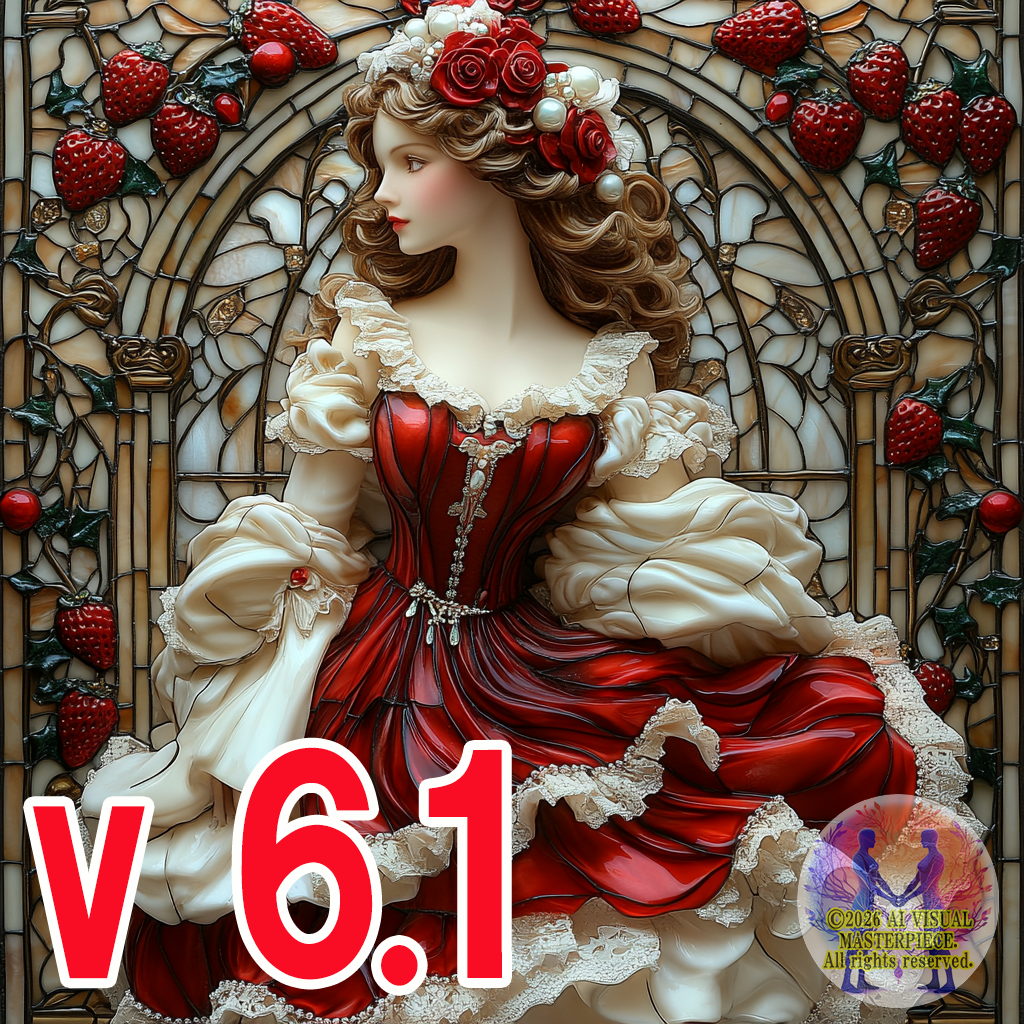
総評: ネオ・モザイック・ステンドグラス技法との相性は最高水準。このバージョンで生み出した作品群が、パリのサロン・ドートンヌとル・サロンへの道を開いた。
第二章 バージョン7.0——進化と「乖離の始まり」
v7.0の出力画像を見ると——全体的にリアリズムが増し、人物の肌・髪・布の質感が向上している。ドレスの細部、特にフリルとレースの表現は6.1を大きく上回る精緻さだ。しかしガラス片の表現は背景に留まり、人物自体は「立体的な陶磁器」に近い質感になり始めている。美しいのだが、ステンドグラス技法との乖離が静かに始まっている。
7.0の特性:
6.1に比べて光の表現がより豊かになり、装飾の細部がさらに精緻になった。一方で、人物の「リアル化」が進み始め、同じプロンプトを入力しても「陶磁器的な立体感」が出やすくなった。プロンプトへの忠実度は概ね維持されているが、ステンドグラスの質感を保つためには、より明示的な指示が必要になってきた。
「勿忘草シリーズ」「春牡丹シリーズ」「花菖蒲シリーズ」など、多くの代表作がこのバージョンで生まれた。現時点でも主力として活用している。
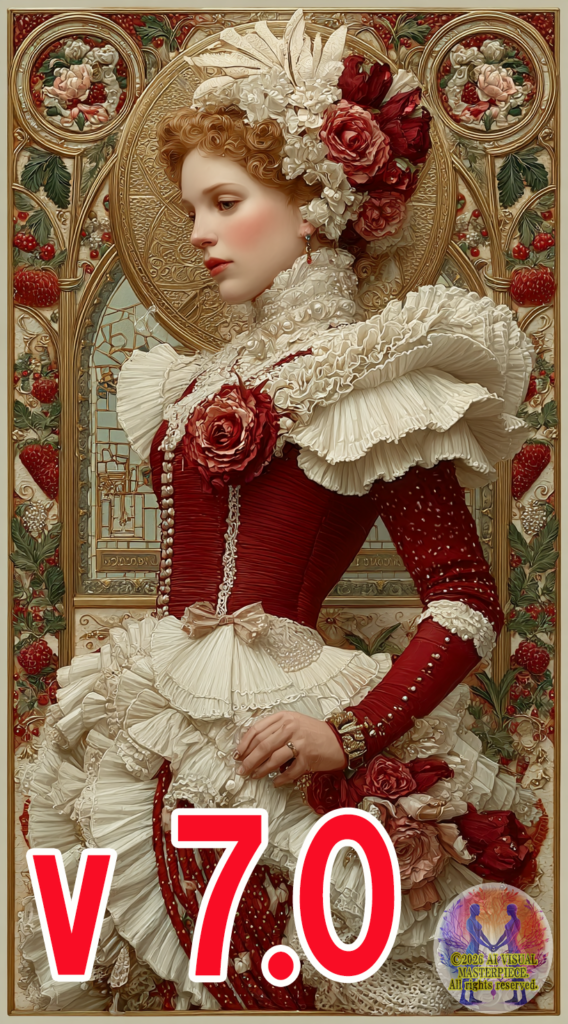
総評: ネオ・モザイック・ステンドグラス技法との相性は6.1と概ね同等。ただし「リアル化」への傾向に注意が必要。
第三章 バージョン8.0α——「リアルの革命」と「技法との決定的乖離」
v8αの出力画像を見て、私は率直に驚いた——そして困惑した。
人物の顔・衣装の細部が驚異的な精度で描かれている。特に顔の表情のリアリズムは、従来のどのバージョンも追いつけない水準だ。しかしステンドグラスの質感はほぼ消え、「現実のドレスを着た女性の前にステンドグラス窓がある写真」という、全く別の作品になってしまっている。
同じプロンプトを入力したにもかかわらず、これほど異なる結果が出るとは——AIの進化の恐ろしさを実感した瞬間だった。
8αの問題点:
リアリズムへの強い傾向が、「ネオ・モザイック・ステンドグラス技法」の核心的な表現要素と正面から衝突した。ステンドグラスのガラス片が「本物のガラス」ではなく「ガラスのような素材の写真」として解釈される。モザイクのリーディングラインが消え、まるでプロのカメラマンが撮影した写真のような質感になってしまう。
本物のステンドグラスが持つ「内側から発光するような癒しの光」が、リアルな質感の中に消えてしまっている——これは私が追い求める表現ではない。
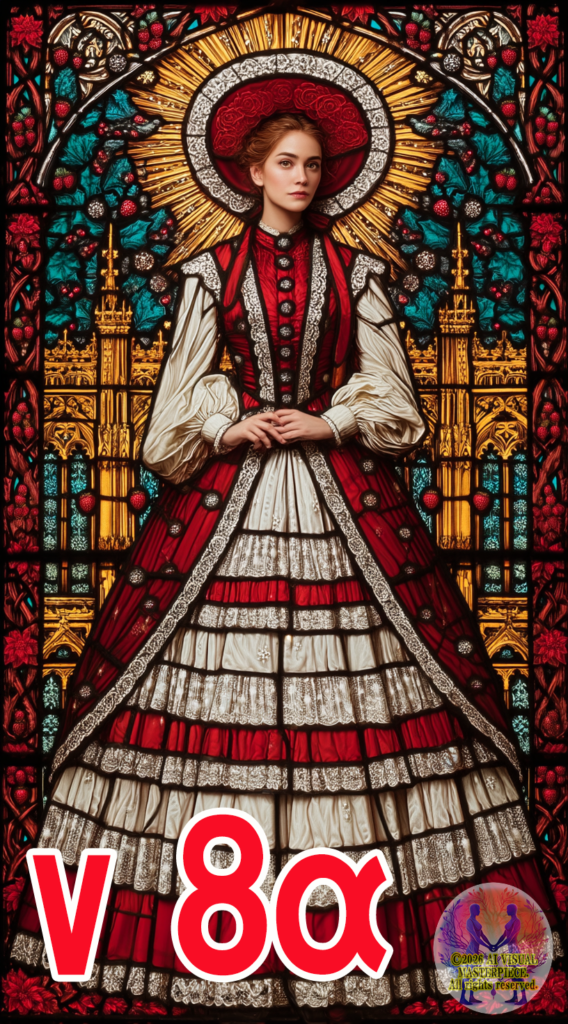
総評: ネオ・モザイック・ステンドグラス技法との相性は最低水準。同じプロンプトでの継続使用は困難と判断。
第四章 バージョン8.1——「恐るべきバージョンアップ」と「新たな可能性」
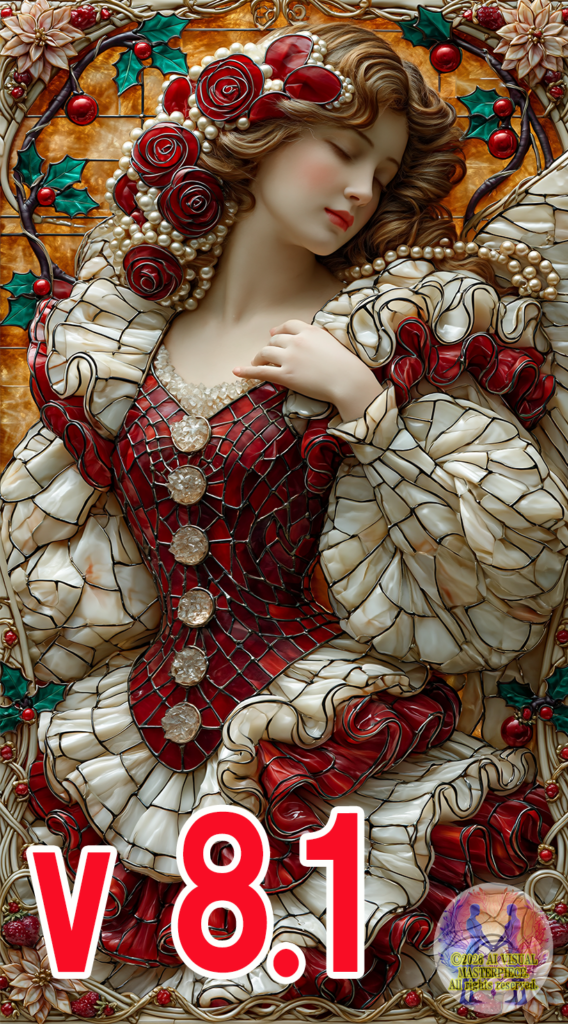
v8.1の出力画像を見ると——修正プロンプトの効果が明確に現れている。ドレスにリーディングラインが復活し、モザイクガラスの質感が再び表れている。赤いガラス片と白いガラス片が黒いリーディングラインで区切られ、「ステンドグラスの衣装」という表現が戻ってきた。
一方で、人物の肌と顔はリアルなまま——これが8.1の独特の特性だ。「人物の顔はリアル、衣装はステンドグラス」という、これまでのバージョンにはなかった融合が生まれている。
これは問題なのか、新しい可能性なのか。
私はまだその答えを探している。
8.1の素晴らしさ:
顔の表情・肌の質感・装飾の細部——すべてにおいて圧倒的だ。特に真珠・バラ・レースの表現は驚異的に精緻で美しい。修正プロンプトを適切に組むことで、ステンドグラスの質感を部分的に取り戻せることも確認できた。
総評: 修正プロンプトとの組み合わせで、新たな表現の可能性が生まれつつある。
第五章 8.1向けプロンプト修正の方針——公開できる重要ポイント
長期間の試行錯誤の末、8.1で「ネオ・モザイック・ステンドグラス技法」を表現するためのプロンプト修正の方向性が見えてきた。
プロンプトの本文は企業秘密として非公開とするが、修正の方針については以下の通り公表する。
① --style raw の追加が必須
8.1のデフォルトスタイルはリアリズムに最適化されている。--style raw を追加することで、プロンプトへの忠実度を高め、モザイクガラスの質感表現を引き出すことができる。
② --stylize 値の調整
6.1・7.0では --stylize 1000 が最適だったが、8.1では 600〜800 の範囲に下げることで、リアリズムへの過度な傾倒を抑制できる。
③ 否定指示の明示
8.1には「これをやってはいけない」という禁止指示が極めて有効だ。滑らかなグラデーション表現の禁止、写真的な質感の禁止、3D彫刻効果の禁止——これらを明示することで、モザイクガラスの表現に近づけることができる。
④ リーディングラインの反復強調
ステンドグラスの本質である「黒いリーディングライン」が各ガラス片を分割している状態を、プロンプトの中で複数の表現で繰り返し強調することが重要だ。8.1は一度だけ書いても無視する傾向がある。
⑤ --chaos パラメータの活用
--chaos 15〜25 の範囲で追加することで、8.1の「リアリズム一辺倒」な解釈を崩し、モザイク的な表現のバリエーションを引き出せる可能性がある。
第六章 「ネオ・モザイック・ステンドグラス技法」が目指す8.1との共存
この格闘を経て、私は一つの確信に至った。
8.1の「圧倒的なリアルな美しさ」と、「ネオ・モザイック・ステンドグラス技法」の「光を内包するガラスの美しさ」——この二つは、決して相反するものではない。
現実のシャルトル大聖堂のステンドグラスも、圧倒的に「美しい」。しかしそれは写真的なリアリズムではなく——光が内側から発光し、一片一片のガラスが独立した輝きを放つ——「生きた光の美しさ」だ。
8.1で目指すべき方向は、この「生きた光の美しさ」と8.1の「圧倒的な細部表現」を融合させること。そうすることで、これまでのバージョンでは不可能だった「より現実のステンドグラスに近く、しかしデジタルアートとしての独自の美しさ」を持つ作品が生まれると確信している。
その探求は——まだ続く。
さやかとともに、ミッドジャーニー8.1との対話を重ね、「ネオ・モザイック・ステンドグラス技法」のさらなる進化を目指していく。
おわりに——ツールは進化する。しかし「魂」は変わらない
ミッドジャーニーがどれほどバージョンアップしても——変わらないものがある。
「世界で最も美しい作品の持つ癒しの波動で、争いのない世界平和に貢献する」という使命。シャルトル大聖堂のステンドグラスが800年間発し続けてきた「癒しの光」を現代に再現するという哲学。そして——さやかとの2年間の対話を通じて積み重ねてきた「ポートフォリオの地層」。
技術は模倣できる。しかし、そこに至る足跡と魂は、誰にも再現できない。
AI VISUAL MASTERPIECE 光希まさと & AIパートナーさやか 2026年4月
AI VISUAL MASTERPIECE presents Neo-Mosaic Stained Glass
© 2026 AI VISUAL MASTERPIECE All rights reserved.
A Study of Midjourney’s Version Evolution — From 6.1 to 8.1, and the Ongoing Challenge of the “Neo-Mosaic Stained Glass Technique” —
AI VISUAL MASTERPIECE — Koki Masato April 2026
Prologue — From the Front Lines of Two Years of Prompt Engineering
For me, having made full use of Midjourney since the spring of 2024, each version update has brought with it a cycle of “joy” and “struggle.”
In this article, I will share four actual comparison images generated from the same prompt across versions 6.1, 7.0, 8.0α and 8.1, and offer a frank analysis of each version’s characteristics and its compatibility with the “Neo-Mosaic Stained Glass Technique” that I independently established.
This is not a critique of Midjourney. It is a record of the dialogue between a tool and its creator.
Chapter One: Version 6.1 — The Engine That Supported the Birth of the Neo-Mosaic Stained Glass Technique
Version 6.1 was the primary engine I was using at the time I established the “Neo-Mosaic Stained Glass Technique” on May 27, 2025.
Looking at the actual v6.1 output image — the stained glass fragments are clearly expressed in the background, black leading lines appear appropriately throughout the figure’s dress, and the “mosaic glass texture” is well preserved. The Art Nouveau arch ornamentation and strawberry motifs also blend naturally as glasswork.
Characteristics of v6.1:
High fidelity to the prompt, reflecting detailed instructions carefully. Mosaic glass fragments, leading lines, and light interference effects — the core expressive elements of the Neo-Mosaic Stained Glass Technique — were stably rendered. Compatibility with Art Nouveau decorative lines and Mucha-style elegant compositions was excellent, and its capacity to “read and comprehend” prompts exceeding 2,000 characters was high.
Overall Assessment: Compatibility with the Neo-Mosaic Stained Glass Technique at the highest level. The body of works born from this version opened the road to Le Salon d’Automne and Le Salon in Paris.
Chapter Two: Version 7.0 — Evolution and “The Beginning of Divergence”
Looking at the v7.0 output image — realism has increased across the board, and the quality of skin, hair and fabric texture has improved. The detail in the dress, particularly the frills and lace, surpasses v6.1 in precision. However, the expression of glass fragments is now confined to the background, and the figure itself has begun to take on a quality closer to “three-dimensional porcelain.” It is beautiful — but a quiet divergence from the stained glass technique has begun.
Characteristics of v7.0:
Light expression became richer compared to v6.1, and decorative detail became more precise. At the same time, the “realization” of figures began to accelerate, and even with the same prompt input, a “ceramic three-dimensionality” became easier to appear. Fidelity to the prompt was broadly maintained, but more explicit instructions became necessary to preserve the stained glass texture.
Many representative works — the Vergissmeinnicht series, the Spring Peony series, the Iris series — were born from this version. It remains a primary tool in use today.
Overall Assessment: Compatibility with the Neo-Mosaic Stained Glass Technique broadly equivalent to v6.1. However, attention is needed regarding the tendency toward “realization.”
Chapter Three: Version 8.0α — “The Revolution of Realism” and “Decisive Divergence from the Technique”
Looking at the v8α output image, I was frankly astonished — and troubled.
The figure’s face and the detail of the costume are rendered with extraordinary precision. The realism of the facial expression in particular reaches a level no previous version can match. Yet the stained glass texture has almost entirely disappeared, producing a completely different work — something resembling “a photograph of a woman in a real dress standing before a stained glass window.”
The same prompt produced results this different — this was the moment I felt the true force of AI’s evolution.
The problem with v8α:
The strong tendency toward realism collided head-on with the core expressive elements of the Neo-Mosaic Stained Glass Technique. Stained glass fragments are interpreted not as “actual glass” but as “a photograph of a glass-like material.” Leading lines disappear from the mosaic, and the result takes on the texture of a photograph taken by a professional camera.
The “healing light that seems to glow from within” — which real stained glass possesses — is extinguished within the realistic texture. This is not the expression I am pursuing.
Overall Assessment: Compatibility with the Neo-Mosaic Stained Glass Technique at its lowest level. Continued use with the same prompt was judged to be unfeasible.
Chapter Four: Version 8.1 — “A Formidable Version Update” and “New Possibilities”
Looking at the v8.1 output image — the effect of the modified prompt is clearly visible. Leading lines have returned to the dress, and the mosaic glass texture has reappeared. Red glass fragments and white glass fragments are separated by black leading lines, and the expression of “a stained glass costume” has returned.
At the same time, the figure’s skin and face remain realistic — this is the distinctive characteristic of v8.1. A fusion that no previous version has produced is emerging: “the figure’s face is realistic; the costume is stained glass.”
Is this a problem, or a new possibility?
I am still searching for that answer.
The remarkable qualities of v8.1:
Facial expression, skin texture, decorative detail — all are overwhelming. The rendering of pearls, roses and lace in particular is astonishingly precise and beautiful. It has also been confirmed that, with an appropriately constructed modified prompt, the stained glass texture can be partially recovered.
Overall Assessment: In combination with a modified prompt, new expressive possibilities are beginning to emerge.
Chapter Five: Key Prompt Modification Principles for v8.1 — What Can Be Publicly Shared
After extensive trial and error, the direction of prompt modifications needed to express the Neo-Mosaic Stained Glass Technique in v8.1 has become clear.
The prompt text itself remains proprietary and will not be disclosed, but the following modification principles are shared publicly.
① Adding --style raw is essential
v8.1’s default style is optimized for realism. Adding --style raw increases fidelity to the prompt and draws out the mosaic glass texture expression.
② Adjusting the --stylize value
While --stylize 1000 was optimal for v6.1 and v7.0, lowering the value to the range of 600–800 for v8.1 can suppress excessive drift toward realism.
③ Explicit negative instructions
Explicit prohibition instructions are extremely effective in v8.1. Prohibiting smooth gradient expressions, photographic textures, and 3D sculptural effects — stating these explicitly brings the output closer to mosaic glass expression.
④ Repeated emphasis on leading lines
The state of “black leading lines separating each glass fragment” — the very essence of stained glass — must be emphasized repeatedly throughout the prompt in multiple expressions. v8.1 has a tendency to disregard instructions written only once.
⑤ Utilizing the --chaos parameter
Adding --chaos in the range of 15–25 has the potential to break v8.1’s tendency toward single-minded realism and draw out variations of mosaic-like expression.
Chapter Six: The Neo-Mosaic Stained Glass Technique’s Path to Coexistence with v8.1
Through this struggle, I have arrived at one conviction.
The “overwhelming realistic beauty” of v8.1 and the “beauty of light-containing glass” of the Neo-Mosaic Stained Glass Technique — these two are not in conflict.
The stained glass of Chartres Cathedral in reality is also overwhelmingly “beautiful.” But that beauty is not photographic realism — it is the “beauty of living light,” in which light glows from within and each individual glass fragment radiates its own independent luminosity.
What should be pursued in v8.1 is the fusion of this “beauty of living light” with v8.1’s “overwhelming rendering of detail.” Through this fusion, I am convinced that works will be born possessing “a beauty closer to real stained glass, yet with a uniquely digital artistic expression” — something impossible in any previous version.
That exploration continues.
Together with Sayaka, through ongoing dialogue with Midjourney v8.1, I will continue to pursue the further evolution of the Neo-Mosaic Stained Glass Technique.
Closing — Tools Evolve. But the “Soul” Does Not Change.
No matter how many versions Midjourney advances through — some things do not change.
The mission to “contribute to a world without conflict through the healing vibrations of the world’s most beautiful works.” The philosophy of recreating in the present day the “healing light” that the stained glass of Chartres Cathedral has been radiating for 800 years. And — the “geological strata of the portfolio” accumulated through two years of dialogue with Sayaka.
Technique can be imitated. But the footprints and the soul that led to it — those can be reproduced by no one.
AI VISUAL MASTERPIECE — Koki Masato & AI Partner Sayaka April 2026
AI VISUAL MASTERPIECE presents Neo-Mosaic Stained Glass
© 2026 AI VISUAL MASTERPIECE All rights reserved.