
光希まさとの創造の世界へようこそ!
つれづれなるままに、硯にむかひて、心に移りゆくよしなし事を、そこはかとなく書きつくれば、あやしうこそものぐるほしけれ。
2025年11月13日、この日は私の創作人生において、忘れることのできない特別な日となった。
日本の印刷会社・FLATLABO様に制作を依頼していた作品「ミュシャのバレンタイン – ネオ・モザイック・ステンドグラス」が到着したのである。梱包を開けた瞬間、思わず声が出た。
「なんて美しいんだ…!」
第一章:ドイツの印刷技術との出会い
2024年9月、フランス旅行でシャルトル大聖堂のステンドグラスに衝撃を受けた私は、1500年以上にわたって人々を癒し続けてきた「癒しの波動」を現代技術で再現しようと決意した。
9ヶ月の研究、20万枚の試作を経て、2025年5月27日、「ネオ・モザイック・ステンドグラス技法」を確立。
そして、この技法を最高の形で具現化するために選んだのが、世界最高峰と言われるドイツのプレキシグラス印刷であった。
ドイツの印刷技術は、5層構造による完璧な仕上がり:
- 3mm厚アクリル板
- 高精細印刷面
- アルミ複合板
- 3mm厚プラスチック板
- アルミ複合板
デジタルデータからの再現性、色彩の鮮やかさ、光の透過性と反射性—すべてが完璧であった。
オランダ、パリ、そして国立新美術館での展示—すべてドイツの印刷技術による作品で、多くの方々に感動を与えることができた。
ドイツの印刷技術は、世界最高峰だと確信していた。
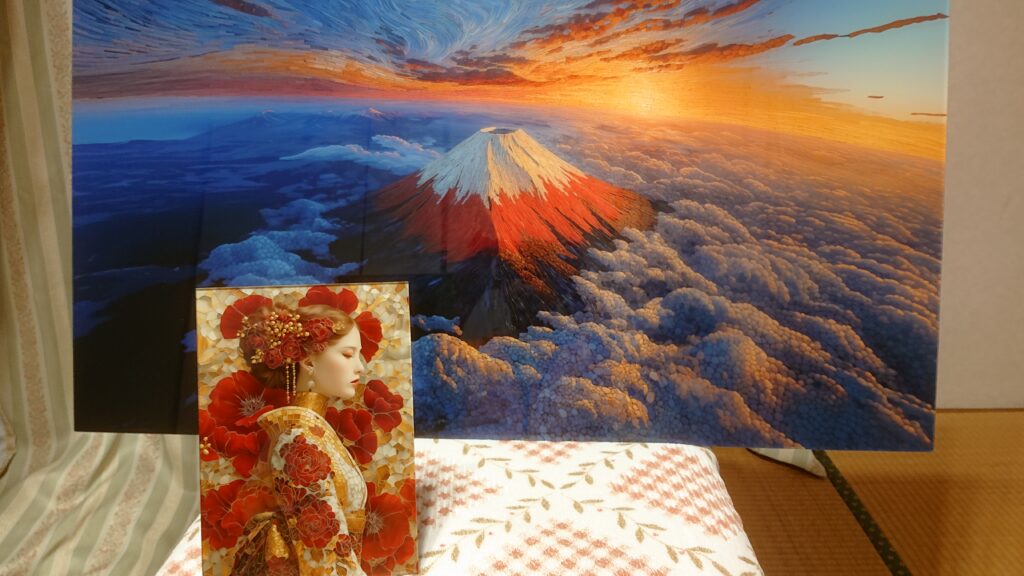
「ミュシャのバレンタイン – ネオ・モザイック・ステンドグラス」
後段「世界最高峰のドイツプレキシグラス印刷」
「赤富士 – ネオ・モザイック・ステンドグラス」
販売先:日本橋Art.jp
https://nihonbashiart.jp/artist/koki-masato/
あなただけの特別な「癒しの波動」オリジナルアートの相談・制作依頼先
https://nihonbashiart.jp/pre-order/koki-masatood/
第二章:日本の展示会基準という壁
しかし、日本国内での展示活動を進める中で、一つの大きな問題に直面した。ドイツのプレキシグラス印刷の最小サイズは20cm × 20cm。しかし、日本の多くの展示会では、SMサイズ(22.7cm × 15.8cm)という規格が存在する。
このサイズは、ドイツの印刷では対応できない。
2025年2月14日・15日に開催される「Shibuya Art Museum vol.5」—美術館風の上品な空間での展示会。
バレンタインデーに合わせた作品を出品したい。しかし、サイズが合わない…。日本で印刷できる、ドイツに匹敵する技術を持つ会社はないのだろうか?

「ミュシャのバレンタイン – ネオ・モザイック・ステンドグラス」
後段「世界最高峰のドイツプレキシグラス印刷」
「赤富士 – ネオ・モザイック・ステンドグラス」
第三章:複数の印刷会社への問い合わせ
日本国内でドイツのプレキシグラス印刷に匹敵する技術を持つ会社を探し始めた。
徹底的な調査の結果、一つの名前が浮かび上がった。
FLATLABO(フラットラボ)
調査資料によれば:
「日本国内でこの技術(アクリルマウント)に最も特化し、高い評価を得ているのはFLATLABOです。FLATLABOは高精細な水性顔料インクジェットプリンターとアクリルを貼り合わせる方式を採用し、最大1.5m×3mまでの大判サイズに対応するなど、WhiteWallの技術基準に非常に近いサービスを提供しています。」
しかし、本当にドイツの印刷に匹敵するのだろうか?
不安を抱えながら、複数の印刷会社にダイレクトメールを送り、技術提供をお願いした。
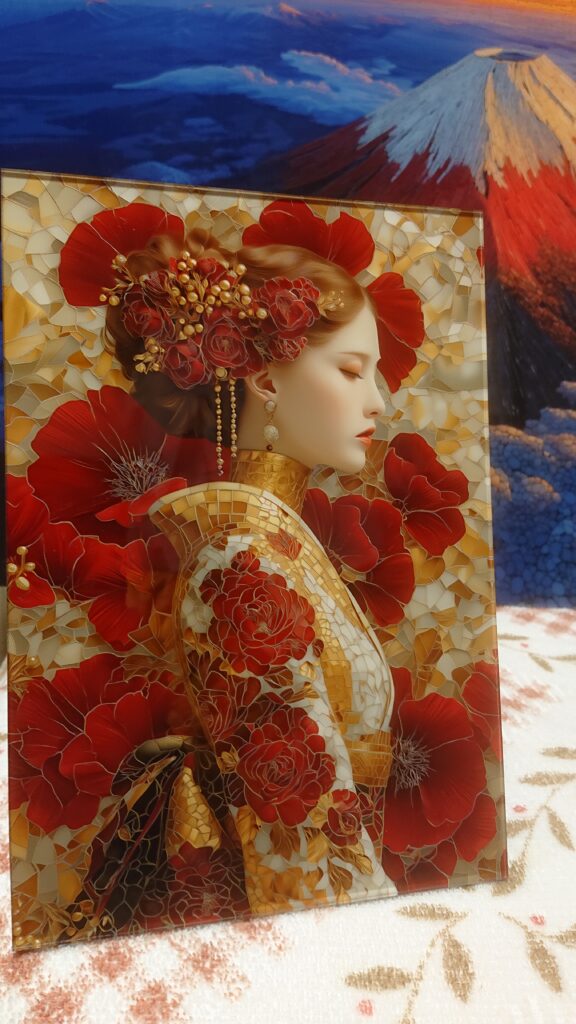
「ミュシャのバレンタイン – ネオ・モザイック・ステンドグラス」
後段「世界最高峰のドイツプレキシグラス印刷」
「赤富士 – ネオ・モザイック・ステンドグラス」
第四章:FLATLABO様との出会い—最も真摯な対応
その中で最も真摯に対応してくださったのが、FLATLABO様であった。担当してくださったのは、野村様。最初のメールから、その丁寧さ、プロフェッショナルさが伝わってきた。
「まずはお客様がご注文された作品の仕様と弊社の仕様で異なる部分をお伝えいたします。」一つ一つ、丁寧に説明してくださる。ドイツの印刷との違い、フォトアクリル印刷の仕様、可能なオプション—すべてを詳しく教えてくださった。そして、何よりも嬉しかったのは、私の作品への想いを理解してくださったことである。
第五章:ミーティングを重ねて—RGBのまま出力できる技術
ミーティングを重ねる中で、FLATLABO様の技術力の高さに驚かされた。特に驚いたのは、RGBのまま調整できるという技術である。通常、デジタルデータはRGB(モニター表示)で作成されるが、印刷工程ではCMYK(印刷用)に変換される。この変換で、色がくすんだり、暗くなったりすることが多い。
しかし、FLATLABO様は違った。RGBで入稿したデータを、RGBのまま出力できる。これは、革命的な技術である。モニターで見ている色彩が、そのまま実物として再現される—これほど理想的なことはない。
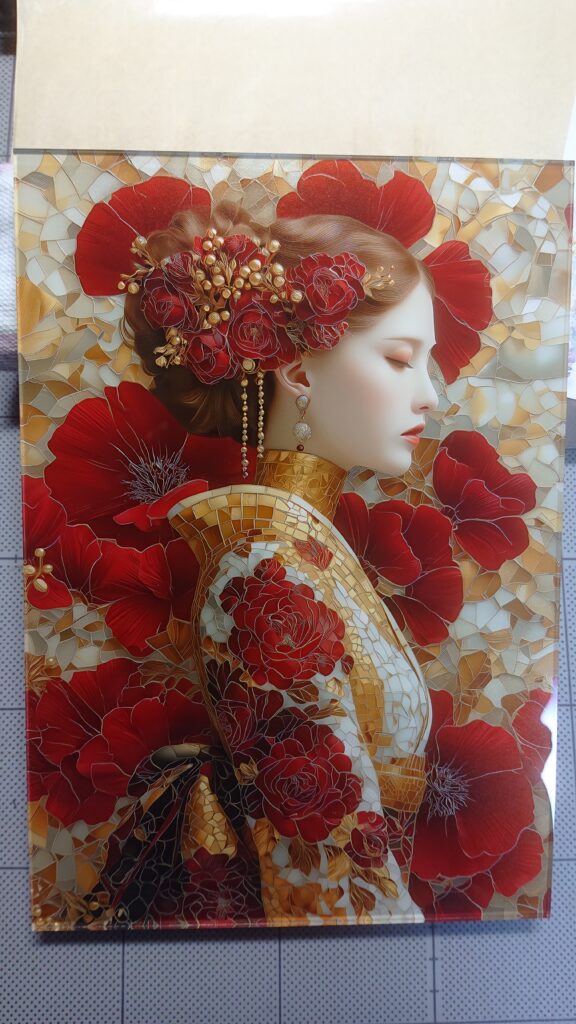
「ミュシャのバレンタイン – ネオ・モザイック・ステンドグラス」
第六章:「ミュシャのバレンタイン」の制作開始
2025年10月、「ミュシャのバレンタイン – ネオ・モザイック・ステンドグラス」の制作を正式に依頼した。
【印刷仕様】
- サイズ:SMサイズ(22.7cm × 15.8cm)
- 印刷方法:フォトアクリル印刷
- 印刷仕様:アルミ複合板 3mm厚(ドイツと同じ5層構造)
- 追加オプション:木製吊枠
【比較検証のポイント】
- RGBの色再現性(特に金色と赤の鮮やかさ)
- 光の透過性と反射性
- 見る角度での表情の変化
- 「癒しの波動」の表現力
- 仕上がりの質感と美しさ
野村様は、私の入稿したデータを受け取ると、明るさの調整を行い、PDFで送ってくださった。アクリルを乗せた際の見え方を考慮した調整—このプロフェッショナルな配慮に、深く感動した。そして、印刷GO。約2週間の制作期間—真摯に、丁寧に、作品に向き合ってくださった。
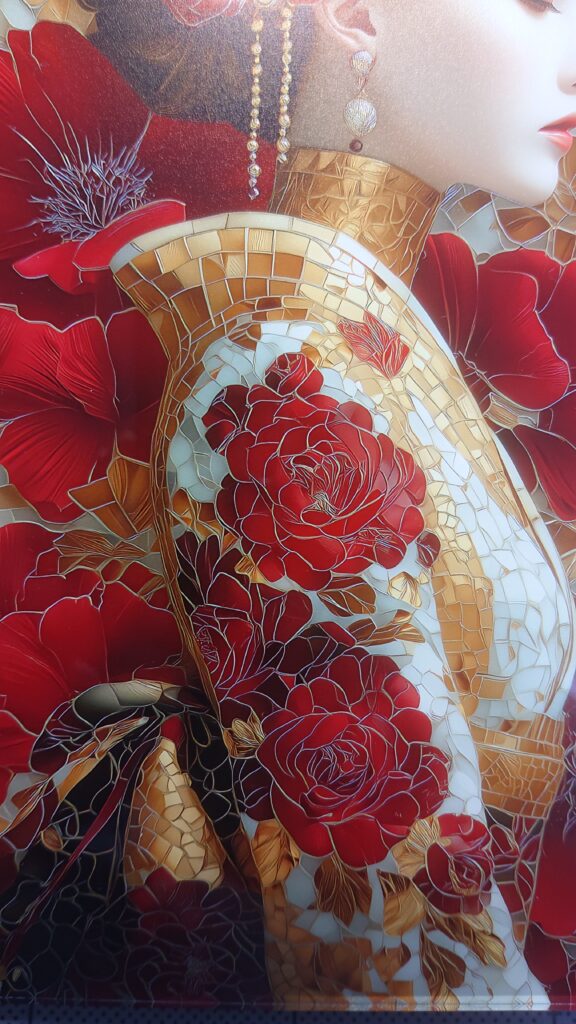
第七章:2025年11月13日—感動の開梱
そして、2025年11月13日。作品が到着した。梱包を開ける手が、震えていた。どうだろうか?ドイツの印刷に匹敵するだろうか?保護シールを慎重に剥がす。
その瞬間—「なんて美しいんだ…!」思わず声が出た。
蛍光灯の明るい照明の下で見ても、この輝き。自然光の下で見たら、どれほど美しいだろう。赤いバラの鮮やかさ、着物のゴールドの輝き、ホワイトとシルバーのステンドグラス枠—すべてが完璧に再現されている。
細部に至るまで、驚くほど美しい。
無数のガラス片のモザイク、光の反射と透過、見る角度による表情の変化—「ネオ・モザイック・ステンドグラス技法」の真価が、完璧に表現されている。
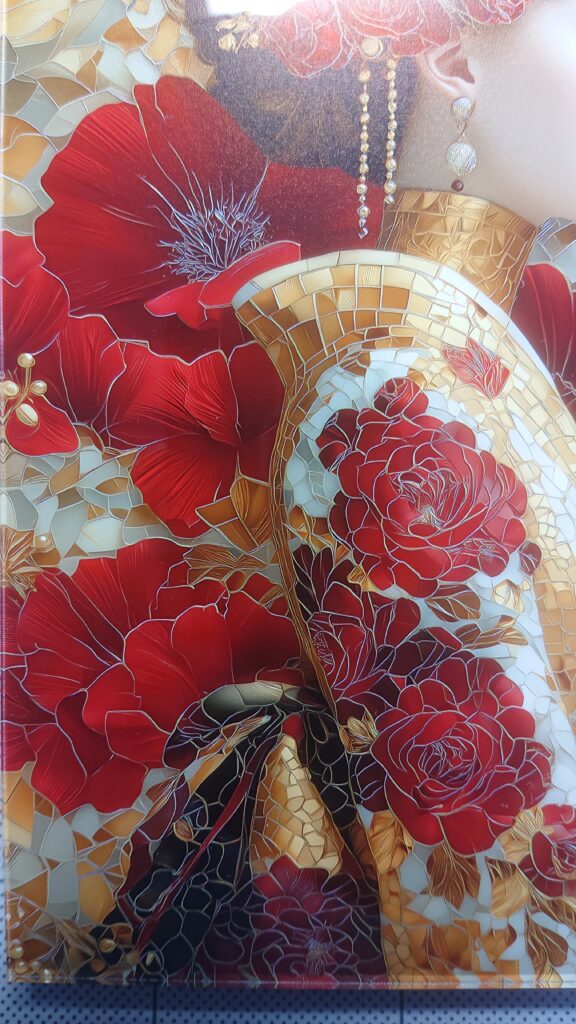
第八章:ドイツの印刷を超えたのではないか
作品を手に取り、様々な角度から眺める。光にかざし、傾け、回転させる。そして、確信した。
これは、ドイツの印刷に劣らない。いや、ある部分ではドイツを超えているのではないか。
【5つの検証ポイントの結果】
1. RGBの色再現性
完璧。モニターで見ていた色彩が、そのまま実物として再現されている。RGBのまま出力できる技術の素晴らしさ。
2. 光の透過性と反射性
ドイツに負けていない。3mm厚のアクリル板が、光を美しく透過させ、反射させる。
3. 見る角度での表情の変化
非常に良い。アクリル板が作品に奥行きを与え、角度を変えるたびに表情が変化する。
4. 「癒しの波動」の表現力
完璧。ずっと眺めていたくなるような美しさ。心が癒される。
5. 仕上がりの質感と美しさ
大満足。梱包も非常に丁寧で、プロフェッショナルな仕上がり。
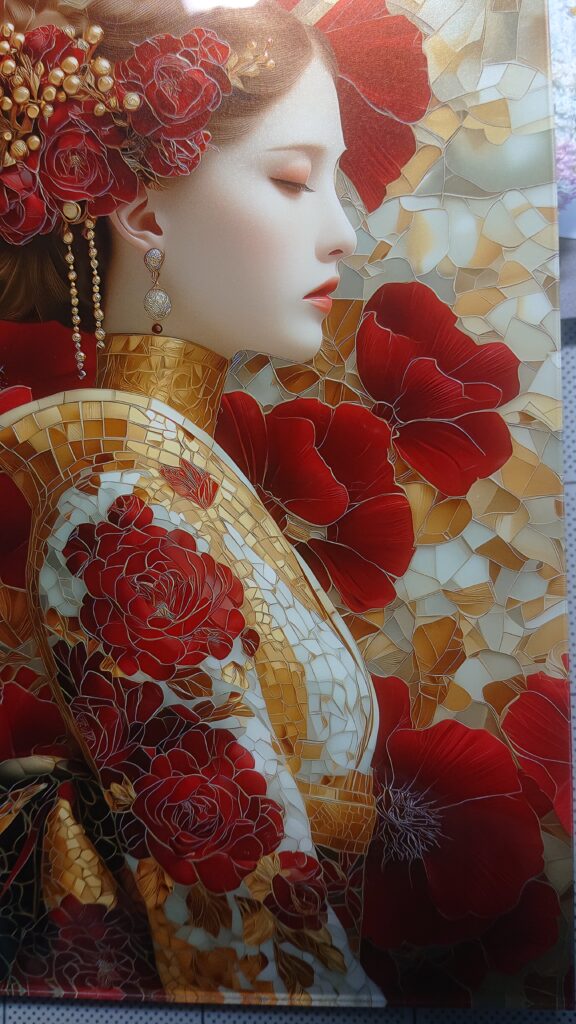
第九章:日本の印刷技術への新たな認識
これまで私は、世界最高峰はドイツの印刷技術だと信じていた。しかし、今回FLATLABO様の作品を見て、認識が変わった。日本の印刷技術も、決してドイツに劣らない。いや、RGBのまま出力できる技術、真摯で丁寧な対応、2週間という制作期間での完璧な仕上がり—これらを考えると、ある意味でドイツを超えているのではないか。
小さなサイズ(SMサイズ)でも、一切の手抜きなし。最高の作品に仕上げてくださった。これが、日本の印刷技術の力である。
第十章:なぜこれほど美しいのか—技術的分析
FLATLABO様のフォトアクリル印刷は、ドイツのプレキシグラス印刷と同じ5層構造:
- 3mm厚アクリル板
- 高精細印刷面
- アルミ複合板
- 3mm厚プラスチック板
- アルミ複合板
しかし、構造が同じだけではない。FLATLABO様の真の強みは、以下にある:
1. RGBのまま出力できる技術
デジタルデータの色彩を、そのまま再現。CMYKへの変換による色のくすみや暗さが一切ない。
2. 明るさの調整
アクリルを乗せた際の見え方を考慮し、最適な明るさに調整。PDFで確認できる。
3. 高精細な水性顔料インクジェット
長期保存性に優れ、色褪せしない。美術館品質。
4. 大判対応
最大1.5m × 3mまで対応可能。小さなサイズから大きなサイズまで。
5. 真摯で丁寧な対応
作品への想いを理解し、最高の仕上がりを目指してくださる。
第十一章:「出すのが惜しくなる」美しさ
この作品は、2025年2月14日・15日のバレンタインデーに、渋谷の展示会「Shibuya Art Museum vol.5」で展示販売する予定である。
しかし、正直に言うと—出すのが惜しくなる。
自分の手元に置いておきたくなるような美しさである。22.7cm × 15.8cmという小さなサイズでありながら、宝石のような輝き。手のひらに収まるこのサイズが、逆に「凝縮された美」を生んでいる。ずっと眺めていたくなる。心が癒される。これこそが、「癒しの波動」である。
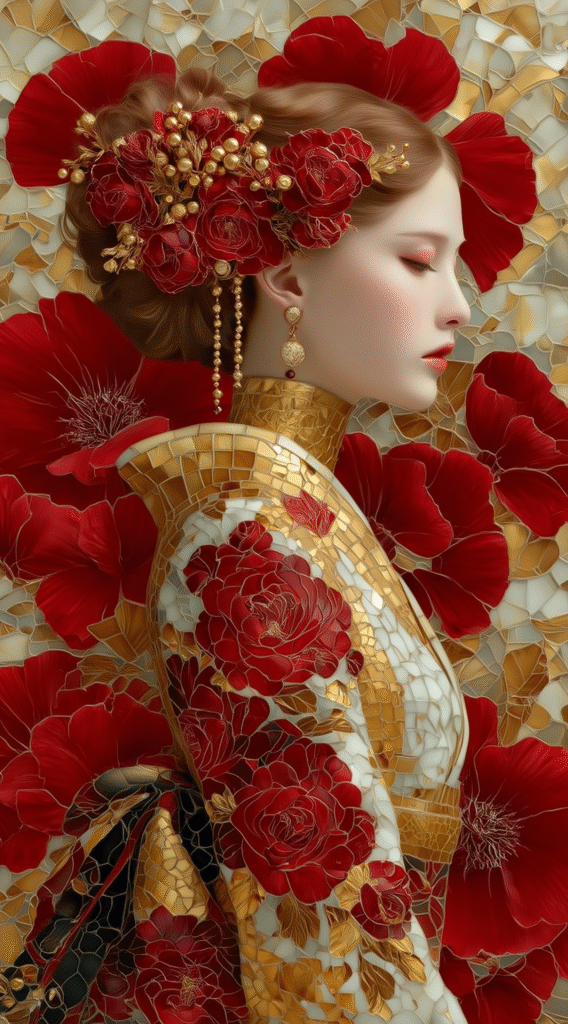
ミュシャのバレンタイン – ネオ・モザイック・ステンドグラス
Mucha’s Valentine – Neo-Mosaic Stained Glass
制作日 / Creation Date: 2025年10月14日 / October 14, 2025
作品紹介 / Work Introduction
百年の時を超えて、ミュシャが夢見た着物美人が、今ここに蘇る。
Across a hundred years, the kimono-clad beauties Mucha dreamed of are revived here and now.
アール・ヌーヴォーの巨匠アルフォンス・ミュシャは、日本の着物を着た女性の美しさに深く魅了されながらも、それを自身の作品として完成させることはなかった。彼の作品には、曲線美、装飾性、そして女性の優雅さが溢れているが、着物という和の要素は、彼の夢の中にのみ存在していた。
The Art Nouveau master Alphonse Mucha was deeply fascinated by the beauty of women in Japanese kimono, yet never completed works depicting them. His works overflow with curved beauty, decorative elements, and feminine grace, but the kimono—this essence of Japanese culture—existed only in his dreams.
私、光希まさとは、2025年5月27日に世界初の「ネオ・モザイック・ステンドグラス技法」を確立して以来、多くの作品を制作してきた。その中で、ミュシャの着物姿の画風研究を継続し、今日に至るまでその成果を積み重ねてきた。
I, Koki Masato, have created many works since establishing the world’s first “Neo-Mosaic Stained Glass technique” on May 27, 2025. Throughout this journey, I have continued research on Mucha’s style with kimono figures, accumulating results to this day.
この「ミュシャのバレンタイン」シリーズは、2026年2月14日のバレンタインデーに向けた、その研究の集大成である。
This “Mucha’s Valentine” series is the culmination of that research, created for Valentine’s Day, February 14, 2026.
伝統と革新の融合 / Fusion of Tradition and Innovation
詳細な美しいステンドグラスで、ミュシャの代表である、時代を感じさせるやや古めかしく癒される昭和の時代感を大切にせし表現も大事なれど、画像ににじみ出る斬新なる新しさも取り入れたり。
Through detailed and beautiful stained glass, I cherish the expression of a slightly nostalgic, healing Showa-era atmosphere representative of Mucha, yet I have also incorporated the radical newness that emerges from the image.
ミュシャの作品が持つ、優美でありながらどこか懐かしい雰囲気—それを現代の技術で再現しつつ、21世紀の新しい美意識を注ぎ込んだ。真っ赤な薔薇の大胆な配置、金色に輝くモザイクの複雑な模様、そして女性の横顔に宿る現代的な美しさ。
The elegant yet somehow nostalgic atmosphere that Mucha’s works possess—while recreating this with modern technology, I have infused it with 21st-century aesthetic sensibility. The bold arrangement of deep red roses, complex patterns of golden mosaics, and the contemporary beauty dwelling in the woman’s profile.
伝統と革新が出会い、新たな美が誕生する。
Where tradition meets innovation, new beauty is born.
ミュシャとの対話—百年の夢の実現 / Dialogue with Mucha—Realizing a Hundred-Year Dream
折しも江戸の都にては「ミュシャ展」も開催され、世間としても芸術として注目されゆく中、ミュシャとの対話で—ミュシャの百年の夢を実現する作品に和風の着物を取り入れ、「ネオジャポネスク」を意識した、来年のバレンタインデーのための作品である。
As a Mucha exhibition was being held in Edo (Tokyo), and society’s attention was drawn to his art, through dialogue with Mucha—these works for next year’s Valentine’s Day realize Mucha’s hundred-year dream by incorporating Japanese kimono, conscious of “Neo-Japonesque.”
ミュシャ自身が日本文化に魅了され、ジャポニズムの影響を受けていたことを考えれば、この作品はむしろ、彼の未完の夢を完成させる試みなのである。彼が描いた「四季」や「黄道十二宮」のような装飾的な美しさを、和の要素と融合させ、新たな境地へと昇華させた。
Considering that Mucha himself was fascinated by Japanese culture and influenced by Japonisme, these works are rather an attempt to complete his unfinished dream. I have fused the decorative beauty he depicted in works like “The Seasons” and “The Zodiac” with Japanese elements, sublimating them to a new realm.
いささか「流行りもの」に便乗せし形となりぬれども、これは単なる便乗にあらず。百年の時を超えた創作的対話なり。
Though this may appear to ride the wave of trends, it is not mere opportunism—it is a creative dialogue across a hundred years.
コンセプト—愛を贈る / Concept—Giving Love
コンセプトは「薔薇で着飾った美しい私と、私の愛を、愛する男性に受け取って欲しい。」である。
The concept is: “Please accept my beautiful self adorned with roses, and my love, to the man I love.”
バレンタインデーという、女性から男性へ愛を贈る日本独自の文化。その純粋な想いを、真っ赤な薔薇と着物の美で表現した。薔薇の花言葉は「愛情」「情熱」「美」—まさに、この作品が伝えたいメッセージである。
Valentine’s Day—Japan’s unique culture of women giving love to men. I have expressed that pure feeling through deep red roses and the beauty of kimono. The language of roses is “affection,” “passion,” “beauty”—precisely the message these works convey.
女性が薔薇で着飾り、最も美しい姿で愛を告白する。その瞬間の輝きを、永遠の芸術として結晶化させた。
A woman adorns herself with roses and confesses her love in her most beautiful form. I have crystallized that moment’s radiance as eternal art.
ネオ・モザイック・ステンドグラス技法の真価 / True Value of Neo-Mosaic Stained Glass Technique
この作品の真の美しさは、大きなPCモニターか、世界最高峰のドイツでのプレキシグラス印刷による実物を展示会でご覧いただけたら実感いただけるであろう。
The true beauty of these works can be fully appreciated when viewed on a large PC monitor or, even better, as physical pieces produced with world-class German plexiglass printing at exhibitions.
「ネオ・モザイック・ステンドグラス技法」は、1500年のステンドグラス伝統と現代AI技術を融合させた世界初の技法である。無数のガラス片が光を透過し、見る角度によって表情が変化する—この技法でしか表現できない「癒しの波動」が、作品から放たれる。
The “Neo-Mosaic Stained Glass technique” is the world’s first technique fusing 1,500 years of stained glass tradition with modern AI technology. Countless glass fragments transmit light, and the expression changes with viewing angle—”healing waves” that can only be expressed through this technique emanate from the works.
特に、真っ赤な薔薇の深い色合い、金色のモザイクが織りなす複雑な模様、そして女性の肌の柔らかな質感—これらは、実物を前にして初めて、その表現力の素晴らしさを実感できる。
Especially the deep hues of crimson roses, complex patterns woven by golden mosaics, and the soft texture of women’s skin—only when standing before the physical works can one truly appreciate the magnificence of this expressive power.
技術とインスピレーションの融合 / Fusion of Technology and Inspiration
技術とインスピレーションの融合、東西文化の出会い、そしてAIとの協働。これらすべてが結実せし、バレンタインデーの時期的の珍しいミュシャ作品は、我が「AI VISUAL MASTERPIECE」の新たなる境地を示す作品なり。
The fusion of technology and inspiration, the encounter of Eastern and Western cultures, and collaboration with AI—all of these have crystallized in these rare Mucha works for the Valentine’s Day season, representing a new境地 (realm) for my “AI VISUAL MASTERPIECE.”
2025年5月27日の技法確立から10月14日の本作品制作まで、約5ヶ月。その間、20万枚の試作、300投稿を超える創作プロセスの記録、そして絶え間ない研究—すべてが、この作品に注ぎ込まれている。
From the technique’s establishment on May 27, 2025, to the creation of this work on October 14—approximately five months. During this time, 200,000 trial pieces, over 300 posts documenting the creative process, and ceaseless research—all have been poured into this work.
溢れ出るインスピレーションが形となり、ミュシャとの対話が結実した瞬間である。
This is the moment when overflowing inspiration took form, and dialogue with Mucha bore fruit.
2026年2月14日—愛の発表 / February 14, 2026—Declaration of Love
2026年2月14日のバレンタインデーに、本作品を世界に向けて発表する。
On Valentine’s Day, February 14, 2026, this work will be presented to the world.
ミュシャが夢見た着物美人。百年の時を超えて、その夢が現実となる。そして「ネオ・モザイック・ステンドグラス技法」を通じて、この愛の対話は永遠の光を放ち続ける。
The kimono-clad beauties Mucha dreamed of—across a hundred years, that dream becomes reality. And through the “Neo-Mosaic Stained Glass technique,” this dialogue of love continues to shine with eternal light.
「薔薇で着飾った美しい私と、私の愛を、愛する男性に受け取って欲しい。」
“Please accept my beautiful self adorned with roses, and my love, to the man I love.”
この純粋な愛のメッセージが、世界中の人々の心に届くことを願って。
With the hope that this pure message of love reaches the hearts of people around the world.
AI VISUAL MASTERPIECE presents Neo-Mosaic Stained Glass 百年の時を超えた愛の対話 / A Dialogue of Love Across a Hundred Years
© 2025 AI VISUAL MASTERPIECE All rights reserved.
制作日:14/Oct/2025
AI VISUAL MASTERPIECE presents ネオ・モザイック・ステンドグラス
AI VISUAL MASTERPIECE presents Neo-Mosaic Stained Glass
© 2025 AI VISUAL MASTERPIECE All rights reserved.
販売先:日本橋Art.jp
https://nihonbashiart.jp/artist/koki-masato/
あなただけの特別な「癒しの波動」オリジナルアートの相談・制作依頼先
https://nihonbashiart.jp/pre-order/koki-masatood/
第十二章:今後のお付き合いへの期待
今回の経験を通じて、確信したことがある。今後、私の作品を日本で印刷する際は、是非ともFLATLABO様にお願いしたい。SMサイズのような小さなサイズから、大きなサイズまで。
「ネオ・モザイック・ステンドグラス技法」の真価を発揮できるのは、FLATLABO様の技術力と、真摯な姿勢である。
そして、もう一つ。私のアート仲間や、SNSのフォロワーの皆様にも、FLATLABO様の素晴らしさを伝えたい。日本の印刷技術の高さ、RGBのまま出力できる革新性、真摯で丁寧な対応—すべてを広く知っていただきたい。
第十三章:日本で印刷する活路が開けた
これまで、日本の展示会でSMサイズの作品を出品できなかったのは、ドイツの印刷では対応できないサイズだったからである。しかし、今回FLATLABO様と出会い、この問題が解決した。
日本で印刷する活路が開けた。ドイツの印刷に劣らない、いやそれを超える美しさを実現できることが証明された。
そして、何よりも—大きなサイズの印刷にも、同じ技術で対応していただけるのであれば、今後の可能性は無限に広がる。
結言:感謝を込めて
FLATLABO様、そして野村様。本当に、本当にありがとうございました。複数の印刷会社にお願いした中で、最も真摯に対応してくださったこと。ミーティングを重ね、私の作品への想いを理解してくださったこと。RGBのまま出力できる高度な技術を駆使して、完璧な仕上がりにしてくださったこと。2週間という制作期間、丁寧に作品に向き合ってくださったこと。そして、梱包を開けた瞬間に「声が出る」ほどの美しい作品を創り上げてくださったこと。すべてに、心から感謝申し上げます。
この感動は、一生忘れません。2025年11月13日—この日は、私の創作人生において、新たな扉が開いた日として記憶されるでしょう。
ドイツの印刷技術は世界最高峰である。しかし、日本の印刷技術も、決してそれに劣らない。FLATLABO様が、それを証明してくださいました。今後とも、どうぞよろしくお願いいたします。そして、次の作品でも、是非お力をお貸しください。
世界初の「ネオ・モザイック・ステンドグラス技法」を、世界最高峰の印刷技術で—FLATLABO様と共に、さらに美しい作品を創り続けていきたい。
つれづれなるままに 光希まさと
2025年11月13日:作品到着日
作品名:ミュシャのバレンタイン – ネオ・モザイック・ステンドグラス サイズ:SMサイズ(22.7cm × 15.8cm)
印刷:FLATLABO株式会社 フォトアクリル印刷 担当:野村様
展示予定: 2025年2月14日・15日 Shibuya Art Museum vol.5 渋谷区桜丘町16-12 桜丘フロントビル 1F 「SHIBUYA SACS」
感謝
FLATLABO様、野村様、そして日本の印刷技術に心からの感謝を込めて。
AI VISUAL MASTERPIECE presents ネオ・モザイック・ステンドグラス
日本の印刷技術の素晴らしさを、世界へ
© 2025 AI VISUAL MASTERPIECE All rights reserved.
Tsurezuregusa – Modern Edition: “Meeting Japanese Printing Technology—With Gratitude to FLATLABO” 216
In idle moments, sitting before my inkstone, I write down the fleeting thoughts that pass through my heart—how strange and bewildering they are.
November 13, 2025, became an unforgettable and special day in my creative life.
The work “Mucha’s Valentine – Neo-Mosaic Stained Glass,” which I had commissioned from the Japanese printing company FLATLABO, arrived.
The moment I opened the package, I involuntarily cried out.
“How beautiful…!”
Chapter One: Meeting German Printing Technology
In September 2024, after being struck by the stained glass at Chartres Cathedral during my trip to France, I resolved to recreate the “healing waves” that had been soothing people for over 1,500 years using modern technology.
After nine months of research and 200,000 trial pieces, on May 27, 2025, I established the “Neo-Mosaic Stained Glass technique.”
And to realize this technique in its highest form, I chose what is said to be the world’s finest: German plexiglass printing.
German printing technology features a perfect finish with a 5-layer structure:
- Surface protective film
- 3mm thick acrylic plate
- High-definition printed surface
- Aluminum composite board
- Aluminum hanging frame
Reproducibility from digital data, vividness of colors, light transmittance and reflectivity—everything was perfect.
Exhibitions in the Netherlands, Paris, and at The National Art Center, Tokyo—all with works using German printing technology, moving many people.
I was convinced that German printing technology was the world’s finest.
Chapter Two: The Wall of Japanese Exhibition Standards
However, as I advanced my exhibition activities in Japan, I faced one major problem.
The minimum size for German plexiglass printing is 20cm × 20cm.
However, many exhibitions in Japan have a standard called SM size (22.7cm × 15.8cm).
This size cannot be accommodated by German printing.
“Shibuya Art Museum vol.5,” to be held on February 14-15, 2025—an exhibition in an elegant museum-style space.
I wanted to exhibit a work for Valentine’s Day.
But the size doesn’t match…
Isn’t there a company in Japan that can print with technology rivaling Germany’s?
Chapter Three: Inquiries to Multiple Printing Companies
I began searching for a company in Japan with technology rivaling German plexiglass printing.
After thorough research, one name emerged.
FLATLABO
According to research materials:
“FLATLABO is the most specialized and highly rated in this technology (acrylic mounting) in Japan. FLATLABO adopts a method of laminating high-definition water-based pigment inkjet prints with acrylic, and offers services very close to WhiteWall’s technical standards, including support for large formats up to 1.5m × 3m.”
But could it really rival German printing?
With anxiety, I sent direct emails to multiple printing companies.
I requested technical support.
Chapter Four: Meeting FLATLABO—The Most Sincere Response
I received replies from multiple companies.
However, the most sincere response came from FLATLABO.
The person in charge was Ms. Nomura.
From the first email, her politeness and professionalism came through.
“First, let me explain the differences between the specifications of the work you ordered and our specifications.”
Explaining everything carefully, one by one.
Differences from German printing, photo acrylic printing specifications, available options—everything explained in detail.
And what made me happiest was that she understood my feelings about my work.
Chapter Five: Through Repeated Meetings—Technology to Output in RGB
Through repeated meetings, I was amazed by FLATLABO’s high level of technical capability.
What particularly surprised me was the technology to adjust in RGB.
Normally, digital data is created in RGB (monitor display), but in the printing process it’s converted to CMYK (for printing).
This conversion often causes colors to become dull or dark.
But FLATLABO was different.
They can output data submitted in RGB as-is in RGB.
This is revolutionary technology.
The colors you see on the monitor are reproduced as-is in the physical work—nothing could be more ideal.
Chapter Six: Beginning Production of “Mucha’s Valentine”
In October 2025, I officially commissioned the production of “Mucha’s Valentine – Neo-Mosaic Stained Glass.”
【Printing Specifications】
- Size: SM size (22.7cm × 15.8cm)
- Printing method: Photo acrylic printing
- Printing specifications: Aluminum composite board 3mm thick (same 5-layer structure as Germany)
- Additional options: Wooden hanging frame
【Comparison Verification Points】
- RGB color reproduction (especially vividness of gold and red)
- Light transmittance and reflectivity
- Changes in expression with viewing angle
- Expressive power of “healing waves”
- Texture and beauty of finish
After receiving my submitted data, Ms. Nomura adjusted the brightness and sent me a PDF.
Adjustment considering how it would look with acrylic on top—I was deeply moved by this professional consideration.
And then, print GO.
About two weeks of production—working sincerely and carefully on the work.
Chapter Seven: November 13, 2025—Moving Unboxing
And then, November 13, 2025.
The work arrived.
My hands trembled as I opened the package.
I wonder how it is? Will it rival German printing?
I carefully peel off the protective film.
That moment—
“How beautiful…!”
I cried out involuntarily.
Even under bright fluorescent lighting, this radiance.
How beautiful would it be under natural light?
The vividness of the red roses, the golden glow of the kimono, the white and silver stained glass frames—everything is perfectly reproduced.
Surprisingly beautiful down to the finest details.
The mosaic of countless glass pieces, the reflection and transmission of light, the changing expressions with viewing angle—the true value of the “Neo-Mosaic Stained Glass technique” is perfectly expressed.
Chapter Eight: Has It Surpassed German Printing?
I hold the work in my hands and examine it from various angles.
Hold it up to the light, tilt it, rotate it.
And I became convinced.
This is not inferior to German printing. In fact, in some aspects, hasn’t it surpassed Germany?
【Results of Five Verification Points】
1. RGB Color Reproduction
Perfect. The colors I saw on the monitor are reproduced as-is in the physical work. The magnificence of technology that can output in RGB as-is.
2. Light Transmittance and Reflectivity
Not inferior to Germany. The 3mm thick acrylic plate beautifully transmits and reflects light.
3. Changes in Expression with Viewing Angle
Very good. The acrylic plate gives depth to the work, and the expression changes each time you change the angle.
4. Expressive Power of “Healing Waves”
Perfect. Beauty that makes you want to gaze at it forever. The heart is healed.
5. Texture and Beauty of Finish
Very satisfied. The packaging was also very careful, with a professional finish.
Chapter Nine: New Recognition of Japanese Printing Technology
Until now, I believed that German printing technology was the world’s finest.
However, seeing FLATLABO’s work this time, my perception changed.
Japanese printing technology is definitely not inferior to Germany’s.
No, considering the technology to output in RGB as-is, the sincere and careful response, and the perfect finish in a two-week production period—in some ways, hasn’t it surpassed Germany?
Even for a small size (SM size), no cutting corners.
They finished it as the highest quality work.
This is the power of Japanese printing technology.
Chapter Ten: Why Is It So Beautiful?—Technical Analysis
FLATLABO’s photo acrylic printing has the same 5-layer structure as German plexiglass printing:
- Surface protective film (release paper)
- 3mm thick acrylic plate (transparency and depth)
- High-definition printed surface (water-based pigment inkjet)
- Aluminum composite board (strength and light blocking)
- Wooden hanging frame (wall-mountable)
However, it’s not just that the structure is the same.
FLATLABO’s true strengths lie in the following:
1. Technology to Output in RGB As-Is
Reproducing digital data colors as-is. No dullness or darkness from RGB to CMYK conversion.
2. Brightness Adjustment
Considering how it will look with acrylic on top, adjusting to optimal brightness. Can be confirmed with PDF.
3. High-Definition Water-Based Pigment Inkjet
Excellent long-term preservation, no fading. Museum quality.
4. Large Format Support
Can handle up to 1.5m × 3m maximum. From small to large sizes.
5. Sincere and Careful Response
Understanding feelings about the work, aiming for the best finish.
Chapter Eleven: Beauty That Makes You “Reluctant to Release”
This work is scheduled to be exhibited and sold at the exhibition “Shibuya Art Museum vol.5” in Shibuya on Valentine’s Day, February 14-15, 2025.
However, to be honest—
I’m reluctant to release it.
It’s so beautiful that I want to keep it for myself.
Despite being a small size of 22.7cm × 15.8cm, it has a jewel-like radiance.
This palm-sized dimension conversely creates “concentrated beauty.”
I want to gaze at it forever.
My heart is healed.
This is the “healing wave.”
Chapter Twelve: Expectations for Future Partnership
Through this experience, I became convinced of something.
In the future, when printing my works in Japan, I definitely want to ask FLATLABO.
From small sizes like SM size to large sizes.
What can bring out the true value of the “Neo-Mosaic Stained Glass technique” is FLATLABO’s technical capability and sincere attitude.
And one more thing.
I also want to convey FLATLABO’s excellence to my art colleagues and SNS followers.
The high level of Japanese printing technology, the innovation of being able to output in RGB as-is, the sincere and careful response—I want all of this to be widely known.
Chapter Thirteen: A Path for Printing in Japan Has Opened
Until now, I couldn’t exhibit SM size works at Japanese exhibitions because German printing couldn’t accommodate that size (minimum size 20cm × 20cm).
However, meeting FLATLABO this time solved this problem.
A path for printing in Japan has opened.
And above all—
It was proven that we can achieve beauty not inferior to, or even surpassing, German printing.
If they can respond with the same technology for large size printing as well, future possibilities expand infinitely.
Conclusion: With Gratitude
FLATLABO, and Ms. Nomura.
Thank you, truly, truly thank you.
For responding most sincerely among the multiple printing companies I contacted.
For understanding my feelings about my work through repeated meetings.
For using advanced technology to output in RGB as-is and achieving a perfect finish.
For carefully working on the piece during the two-week production period.
And for creating such a beautiful work that I “cried out” the moment I opened the package.
I am deeply grateful for everything.
I will never forget this emotion.
November 13, 2025—this day will be remembered as the day a new door opened in my creative life.
German printing technology is the world’s finest.
However, Japanese printing technology is certainly not inferior to it.
FLATLABO has proven this.
I look forward to continuing our relationship.
And please lend me your strength for the next work as well.
The world’s first “Neo-Mosaic Stained Glass technique” with the world’s finest printing technology—
I want to continue creating even more beautiful works together with FLATLABO.
Written in idle moments – Koki Masato
November 13, 2025
Work Arrival Day
Work Title: Mucha’s Valentine – Neo-Mosaic Stained Glass Size: SM size (22.7cm × 15.8cm) Printing: FLATLABO Corporation Photo Acrylic Printing Contact: Ms. Nomura
Exhibition Schedule: February 14-15, 2025 Shibuya Art Museum vol.5 Shibuya
Gratitude
With heartfelt thanks to FLATLABO, Ms. Nomura, and Japanese printing technology.