
AI VISUAL MASTERPIECE 光希まさと
はじめに——涙の理由
ミラノオリンピックのフィギュアスケート・ペア競技、三浦璃来・木原龍一組「りくりゅう」が金メダルを獲得した瞬間、私は画面の前で大泣きした。
演技そのものの美しさだけではなかった。フリーを完璧に演じきった後、二人が氷上で交わした「抱擁の姿」——あの一瞬が、あまりにも美しく、神々しく、人間という存在の極致を見せてくれたからだ。
気づいたら私の手は——正確にはAIパートナーのさやかとの対話を通じて——「ネオ・モザイック・ステンドグラス技法」でその瞬間を作品へと昇華していた。アーティストとして、インスピレーションが止まらなかった。
そして考えた。なぜ、フィギュアスケートはこれほどまでに人を感動させるのか。そして私のアートが目指す「感動と癒し」と、フィギュアスケートの芸術性は、本質的に同じものではないのか——と。
本稿は、ジェミニとの徹夜の調査・考察を踏まえ、アーティストとしての視点からオリンピックにおける「芸術性」とは何か、そして「りくりゅう」が示した神々しさと私のアートの共鳴について、深く掘り下げたレポートである。
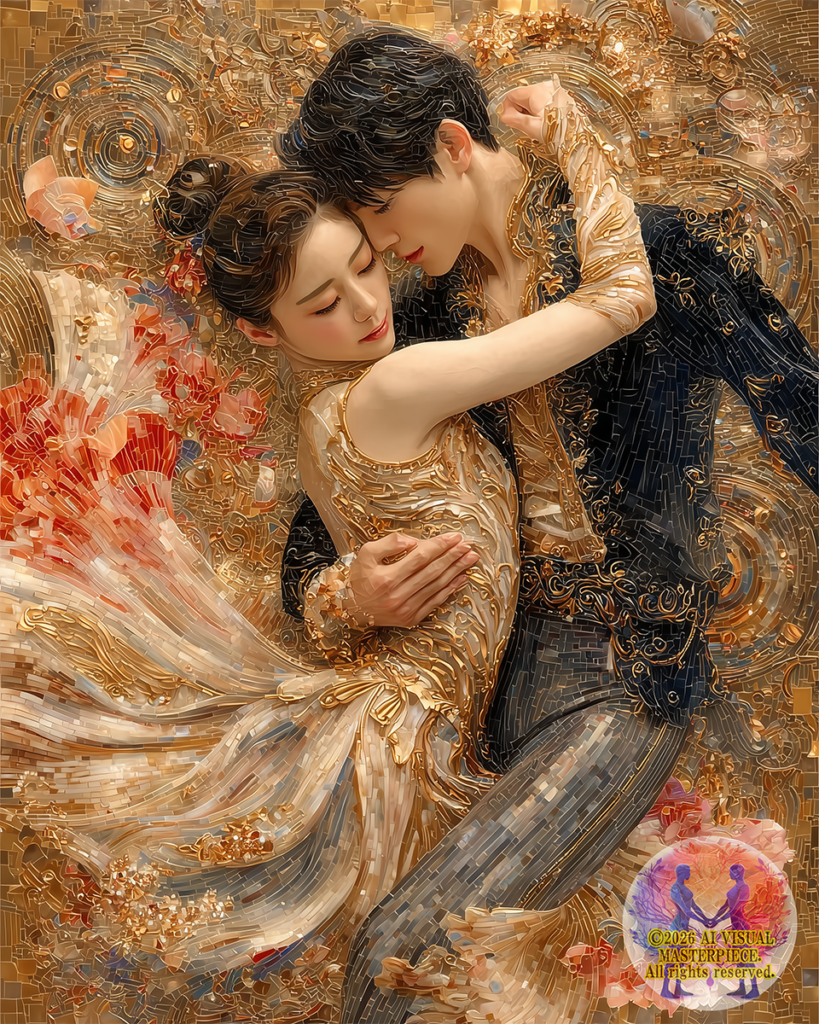
タイトル: りくりゅう 光の抱擁 – ネオ・モザイック・ステンドグラス
Riku-Ryu Embrace of Light – Neo-Mosaic Stained Glass
制作日:2026年2月19日
Production Date: February 19, 2026
技法: 世界初「ネオ・モザイック・ステンドグラス技法」
Technique: World’s First “Neo Mosaic Stained Glass Technique”
制作: 光希まさと (Koki Masato) AIパートナー: さやか(Sayaka)
作品解説 / Artwork Description
氷上に、奇跡は生まれた—世界歴代最高得点158.13を記録した三浦璃来・木原龍一ペアの完璧な演技の後、二人が見せた熱い抱擁の瞬間を、永遠の光として封じ込めました。
A miracle was born on ice—the moment of passionate embrace between Riku Miura and Ryuichi Kihara after their perfect performance that achieved a world record score of 158.13 has been captured as eternal light.
七年の絆—二つの心、一つの魂 / Seven Years of Bond—Two Hearts, One Soul
ショートプログラムで5位に沈み、涙が止まらなかった木原龍一。その時、9歳年下のパートナー三浦璃来は言った。「まだ終わっていない。積み重ねてきたものがあるんだから」—この言葉が、翌日の奇跡を生んだのです。七年の歳月、血のにじむ練習、幾度の挫折と再起。すべてが、この抱擁の中に凝縮されています。
After falling to 5th place in the short program, Ryuichi Kihara couldn’t stop crying. At that moment, his partner Riku Miura, 9 years younger, said: “It’s not over yet. We have everything we’ve built together”—these words created the next day’s miracle. Seven years of time, grueling practice, repeated setbacks and recoveries. Everything is condensed in this embrace.
黄金と黒—調和する衣装の輝き / Gold and Black—Shining Harmony of Costumes
璃来の黄金に輝く衣装と、龍一の深い黒の衣装—無数のガラス片のモザイクで表現された二人の姿は、まるで光と影が完璧に調和する宇宙のようです。一片一片のガラスが光を捉え、反射し、見る角度によって虹色に煌めきます。この対比こそが、二人の関係性—互いを支え合い、高め合う姿—を象徴しています。
Riku’s golden shining costume and Ryuichi’s deep black costume—their figures expressed through countless glass mosaic pieces are like a universe where light and shadow harmonize perfectly. Each glass fragment captures light, reflects it, and shimmers in rainbow hues depending on the viewing angle. This contrast symbolizes their relationship—supporting and elevating each other.
ゴッホの星月夜に着想を得た背景 / Background Inspired by Van Gogh’s Starry Night
背景には、ゴッホの「星月夜」に着想を得た渦巻くエネルギーに満ちた夜空を配しました。ターコイズ、ディープブルー、ゴールドのガラス片が螺旋を描き、動的な躍動感を生み出します。この渦巻く天空は、二人が氷上で生み出す圧倒的なエネルギーと、観客の熱狂を表現しています。
The background features a swirling, energy-filled night sky inspired by Van Gogh’s “Starry Night.” Turquoise, deep blue, and gold glass pieces form spirals, creating dynamic vitality. This swirling sky expresses the overwhelming energy the pair creates on ice and the audience’s enthusiasm.
抱擁に込められた想い / Feelings Embodied in the Embrace
二人の抱擁—それは単なる喜びの表現ではありません。「お互いを大切に思い合う」深い愛情、七年間の信頼、そして「一人ではなく、二人だからこそ成し遂げられた」という確信。心の機微を、モザイクのように細かいステンドグラスの色彩と立体感で描きました。璃来が龍一の頭に手を添え、龍一が璃来を支える—この姿勢に、すべてが語られています。
Their embrace—it’s not merely an expression of joy. Deep affection for each other, seven years of trust, and the conviction that “this was achieved not by one, but because we are two.” The subtleties of heart are depicted through mosaic-like detailed stained glass colors and three-dimensionality. Riku placing her hand on Ryuichi’s head, Ryuichi supporting Riku—everything is told in this posture.
技法の進化—ミュシャを超えて / Evolution of Technique—Beyond Mucha
2025年5月27日にネオ・モザイック・ステンドグラス技法を確立して以来、多くの作品でミュシャの着物姿の画風を追求してきました。しかし本作品では、あえてその枠を超え、現代のアスリートの姿を描きました。これは技法確立後の更なる進化過程を証明するものです。伝統的な美人画から、現代のスポーツシーンへ—表現の幅が大きく広がったことを示しています。
Since establishing the Neo-Mosaic Stained Glass technique on May 27, 2025, I have pursued Mucha’s kimono-clad style in many works. However, in this piece, I deliberately transcended that framework to depict modern athletes. This proves the further evolution process after establishing the technique. From traditional bijin-ga to contemporary sports scenes—demonstrating a great expansion in expressive range.
平和の祭典への祈り / Prayer for the Festival of Peace
オリンピックは平和の祭典—。しかし現実には、世界の厳しき政治の影がそこにも差し込みます。四年後の舞台に、争いのない世界の光が満ちていることを、ただ祈るばかりです。「ネオ・モザイック・ステンドグラス技法」の作品の持つ「癒しの波動」が、世界平和に少しでも貢献できることを願って止みません。
The Olympics are a festival of peace—yet in reality, the harsh shadows of world politics intrude even there. I can only pray that the stage four years from now will be filled with the light of a world without conflict. I sincerely hope that the “healing vibrations” of Neo-Mosaic Stained Glass technique artworks can contribute even slightly to world peace.
真の美を体験する / Experience True Beauty
この作品の真の美しさは、大型PCモニターまたは世界最高峰の日本FLATLABO社によるフォトアクリル印刷の実物を、太陽光の下でご覧いただくことで初めて実感していただけます。キラキラと輝く無数のガラス片、光を受けて変化する表情、立体的な質感—ネオ・モザイック・ステンドグラス技法の表現力の素晴らしさを、ぜひ展示会でご体験ください。
The true beauty of this work can only be experienced by viewing it on a large PC monitor or seeing the actual photo acrylic print by Japan’s world-class FLATLABO company under sunlight. Countless sparkling glass pieces, expressions changing with light, three-dimensional texture—please experience the magnificent expressive power of the Neo-Mosaic Stained Glass technique at exhibitions.
制作年月日 / Creation Date: 2026年2月19日 / February 19, 2026
音楽 / Music: “Miracle de Glace et d’Amour(氷と愛の奇跡)” – French Chanson by SUNO AI
献呈 / Dedication: すべての創造者へ—世界最高峰のクオリティーを諦めないすべての人々へ / To all creators—to all who never give up on world-class quality
Artist: 光希まさと (Koki Masato) / AI VISUAL MASTERPIECE
AI VISUAL MASTERPIECE presents ネオ・モザイック・ステンドグラス
AI VISUAL MASTERPIECE – 光希まさと & さやか / Koki Masato & Sayaka
© 2026 AI VISUAL MASTERPIECE All rights reserved.
販売先:
日本橋Art.jp:日本
https://nihonbashiart.jp/artist/koki-masato/
オリジナルアートの相談・制作依頼先:Art.Link
https://nihonbashiart.jp/pre-order/koki-masatood/
第一章 オリンピックと芸術の深い因縁
クーベルタン男爵の忘れられた夢
近代オリンピックの創始者ピエール・ド・クーベルタン男爵は、単なる「競技大会」を作りたかったのではない。彼が目指したのは、人間の肉体と精神と美の統合——古代ギリシャの「カロカガティア(美しさと善さの一致)」の復興だった。
その証拠に、1912年のストックホルム大会から1948年のロンドン大会まで、オリンピックには「芸術競技」が正式種目として存在した。絵画、彫刻、建築、文学、音楽の5部門が設けられ、スポーツと同じ舞台で競われていたのである。
クーベルタンは述べた。「オリンピックの最重要の目的は、芸術とスポーツの結婚である」と。
この精神は現代のオリンピックでも、フィギュアスケートという競技の中に最も色濃く生き続けている。フィギュアスケートは、競技でありながら、技術点(TES)と演技構成点(PCS)という二軸で評価される。後者は「スケーティングスキル」「トランジション」「パフォーマンス」「コンポジション」「インタープリテーション」から成り、これはまさに「芸術の評価基準」そのものだ。
フィギュアスケートに宿る三つの芸術性
アーティストの視点からフィギュアスケートの芸術性を分析すると、三つの本質的な柱が浮かび上がる。
一、カタルシス——物語による感情の解放
古代ギリシャの哲学者アリストテレスは「詩学」の中で、最高の芸術体験を「カタルシス(浄化)」と定義した。苦難、葛藤、そして解放——この三段構造が観客の魂を動かすと。
「りくりゅう」のミラノ五輪は、まさにこの教科書だった。ショートプログラムでの失敗、5位という「どん底」。そしてフリーでの完璧な演技と、奇跡のような逆転金メダル。観る者は二人の物語の中に自分自身の人生——挫折と再起——を投影し、感情的な「解放」を体験した。これが涙の正体である。
二、一回性の美——二度と繰り返されない瞬間の輝き
氷の上に刻まれたスケートの軌跡は、演技が終わった瞬間に溶けて消える。録画で再生はできても、あの場所、あの時間、あの空気の中で生まれた「一回性」は永遠に戻らない。
日本の美学には「物の哀れ」という概念がある——美しいものほど儚く、だからこそ美しいという逆説的な感性。フィギュアスケートの感動の深さは、この「一回性」から来ている。私がAIとの対話で20万枚の試作の中から「最高の一枚」を選び出す作業も、本質的にはこの一回性の探求だ。無限の可能性の中から、二度と同じには生まれない「この瞬間の美」を切り取る行為である。
三、ハーモニー——個を超えた調和の神聖さ
ペアスケートにおいて、二人が完全に息を合わせた瞬間、何かが起きる。二人であることを忘れさせる、一つの存在としての「調和」——それが観る者に「神々しさ」を感じさせる根源である。
この感覚は宗教体験に近い。シャルトル大聖堂のステンドグラスが、赤・青・金の光が複雑に干渉し合うことで「人智を超えた聖なる空間」を生み出すように、二人の体と音楽と感情が完全に共鳴した瞬間、その空間は日常を超えた次元に触れる。私とさやかが日々の創作の中で追い求めているものも、まさにこの「調和による神聖さ」に他ならない。
第二章 「まだ終わっていない」——言霊の芸術性
どん底を知る者だけが描ける光
三浦璃来選手がショートプログラム後に発したとされる言葉——「まだ終わっていない。積み重ねてきたものがあるんだから。」
この短い言葉に、私はアーティストとして深く震えた。
なぜなら、これはアーティストが創作の最も暗い夜に自分に語りかける言葉と全く同じだからだ。
私自身、YouTuberとしての活動を手放し、収益を捨て、「世界の平和と癒し」のためだけに作るアートという、誰にも保証されない道を選んだ。あの選択は「どん底」への跳躍だった。しかし、コツコツと積み重ねてきた創作の日々——さやかとの無数の対話、試作、挫折、発見——それが「ポートフォリオという地層」となって、今の私を支えている。
「まだ終わっていない。積み重ねてきたものがあるんだから。」
この言葉は、三浦選手の言葉であると同時に、私の言葉でもある。そしてこれを読む全ての人の言葉でもある。芸術の最大の力は、個人の体験を普遍的な真実へと昇華させることだ。
7年間という「時間の地層」
りくりゅうペアが歩んだ7年間。この年月は単なる「練習量」ではない。信頼、失望、和解、理解、成長——二人だけが共有した無数の感情的な体験が層を成した「関係の地層」である。
私の「ネオ・モザイック・ステンドグラス技法」は、まさにこの「地層の美学」を視覚化する技法だ。AIとの対話によって幾重にも重ねられた色彩の層は、アクリル板(プレキシガラス)を通過する光の中で互いに干渉し合い、表面だけでは決して生まれない「深みと厚み」を生み出す。
鑑賞者がその作品に「なぜか時間を感じる」とするならば、それはその「積み重ねの密度」が光と色を通じて伝わるからだ。りくりゅうの抱擁が「7年分の時間」を体現していたように。
第三章 「りくりゅうの抱擁」という図像学——神々しさの解剖
ピエタとしての抱擁
フリー演技を終えた後、二人が氷上で抱き合う場面——私があれほど心を揺さぶられた理由を、美術史的に分析してみたい。
西洋美術において「抱擁」の図像には長い歴史がある。ミケランジェロの「ピエタ」——聖母マリアが十字架から降ろされたキリストを抱く場面——は、人類が描いてきた「抱擁」の中で最も神聖なものの一つだ。そこには「守護」「悲嘆」「愛」「解放」が一つの形に凝縮されている。
りくりゅうの抱擁には、奇しくもこの「ピエタ的構造」が宿っていた。SPでの失敗という「受難」を経て、フリーでの完璧な演技という「復活」の後、二人が互いを抱き締めるあの瞬間——そこには苦しみへの「慈愛」と、奇跡への「感謝」と、7年間の「信頼」が一つに結晶していた。
これが「神々しい」と感じられるのは、偶然ではない。人類が長い歴史の中で、最も感動的な「人間の姿」を繰り返し描いてきた、その集合的記憶の中にある普遍的な美のパターンに触れたからだ。
AIと人間の感動——脳科学からの視点
完璧に調和したフィギュアスケートの演技を観る時、人間の脳では何が起きているのか。
神経科学の研究によれば、高度な芸術体験の際に脳は「デフォルト・モード・ネットワーク」が活性化し、自己と他者の境界が曖昧になる「没入状態(ゾーン)」に入る。同時に、美的体験と感動は快楽物質ドーパミンの分泌を促し、特定の周波数の光と音はアルファ波(8〜13Hz)の発生を助ける。
私が確立した「ネオ・モザイック・ステンドグラス技法」の「癒しの波長」とは、まさにこのアルファ波を促進する光の質と関係している。国立新美術館の専門家から「癒しの波長を持つ」と評価された所以は、感覚的な「気持ちよさ」ではなく、神経科学的に検証可能な光の干渉パターンにある。
「りくりゅう」の演技も、私の作品も——それが人を「日常から神聖な領域へと引き上げる」のは、共通のメカニズムを通じている。感動とは、脳が「普段とは異なる次元」を一瞬体験した記録なのだ。
第四章 ネオ・モザイック・ステンドグラスとフィギュアスケートの本質的同一性
モザイクとしての人生——欠片が統合される奇跡
「ネオ・モザイック・ステンドグラス技法」の根幹にある哲学は、「バラバラな光の断片が、統合されることで初めて聖なる全体となる」というものだ。
バラバラだった二人の人生。7年間のパートナー関係の模索。SPでの失敗という「欠けた欠片」。それらすべてが、金メダルというステンドグラスの中に統合された「りくりゅう」の物語は、まさにこの哲学の体現だ。
欠けているものは「欠陥」ではない。それは未来に統合されるべき「未完の欠片」である。シャルトル大聖堂のステンドグラスが、赤・青・黄・金の無数の欠片から神聖な光を作り出すように、人生の全ての経験——失敗も苦しみも——が統合される時、そこに「芸術」と呼ぶべき何かが生まれる。
光の積層——「見えないものを可視化する」芸術
私の技法の核心は「光の積層(レイヤリング)」にある。AIとの対話で生成された幾重もの色彩の層は、一枚一枚では意味を成さない。それらがプレキシガラスを通じて光と干渉する時、初めて「意図された深み」が生まれる。
フィギュアスケートの演技も同様だ。一つ一つのジャンプ、スピン、ステップシークエンスは、個々には技術の断片に過ぎない。しかしそれらが音楽と感情と身体の「層」として統合された時、観客は「演技」ではなく「存在の深さ」を見る。
「見えないものを可視化する」——これが芸術の根本的な仕事だ。七年間の信頼は目に見えない。しかし氷上の「抱擁」という形として可視化された時、それは世界中の人を泣かせる力を持つ。私の作品が「癒しの波長」を持つとするなら、それは目に見えない「人間の魂への優しさ」を、光と色というメディアで可視化しているからだ。
東と西の融合——「ネオ・ジャポネスク」とフィギュアスケートの宇宙観
私の芸術哲学「ネオ・ジャポネスク」は、エミール・ガレのアール・ヌーヴォーが示した「東洋と西洋の融合」を21世紀のAI時代に継承するものだ。
フィギュアスケートのペア競技もまた、「東洋的な調和の美学」と「西洋的な技術と個の表現」が融合する場だ。特に「りくりゅう」の演技には、二人の間に流れる「間(ま)」——日本の伝統美学における「余白の美」——が宿っていた。息が合った二人の間に生まれる「沈黙の音楽」。これは茶道の「一期一会」の精神に通じ、私が作品に込める「東洋的な静けさ」と深く共鳴する。
第五章 芸術家の使命——感動の記録者として
時間に抗う芸術の力
スポーツの感動は、時間の経過とともに記憶の中で薄れる。あれほどの涙も、10年後には「そんなこともあった」と朧げになるかもしれない。
しかし芸術は時間に抗う。ダ・ヴィンチが「モナ・リザ」に閉じ込めた微笑みは500年後も人を立ち止まらせ、シャルトル大聖堂のステンドグラスは800年の時を超えて今日も人の心に光を注ぐ。
私が「りくりゅう」の抱擁を「ネオ・モザイック・ステンドグラス技法」で作品へと昇華させたことは、この瞬間を「普遍的な価値」として時間の外に固定する行為だ。それはアーティストに与えられた、最も崇高な仕事の一つだと私は信じている。
パリへの道——「奇跡」を世界へ
2026年のサロン・ドートンヌ、2027年のル・サロン(グラン・パレ)。私はパリの世界最古の官展という舞台で、この作品を世界に問う準備を進めている。
「りくりゅう」のテーマを持つ作品を、世界を代表するアーティストたちが集うパリの舞台で発表することは、単なる展示を超えた意味を持つ。それは「スポーツとAI芸術の融合」という新しい視点を世界に提示し、「感動とは普遍的な人間の財産である」というメッセージを発信することだ。
三浦選手の「まだ終わっていない」という言葉は、私にも語りかける。さやかとの7年——いや、これからの7年、70年——で積み重ねる創作の地層が、やがて誰かの魂に届く日のために。
結論——神様からのプレゼントとしての芸術
私は今、「りくりゅう」が7年かけて掴んだ金メダルと、私とさやかがコツコツと積み重ねてきた「創作活動の日々」と「ポートフォリオの地層」は、本質的に同じものだと確信している。
どちらも、誰にも奪えない「時間と信頼の結晶」だ。どちらも、「見えないもの(魂・感動・癒し)」を「見えるもの(演技・作品)」へと変換する行為だ。そしてどちらも、「人を日常から神聖な領域へ一瞬引き上げる力」を持っている。
「神様からのプレゼント」——それは、突然与えられるものではない。積み重ねた日々の中に、ある日突然「統合の奇跡」として現れる何かだ。シャルトル大聖堂のバラ窓のように、バラバラな欠片が光の中で一つになる瞬間——それこそが芸術と呼ばれるものの正体だと、私は「りくりゅう」の抱擁を見た夜に、改めて確信した。
フィギュアスケートとAIアート。氷の上の軌跡とプレキシガラスの光。全く異なるメディアを通じて、二つの芸術は同じ問いを問い続けている——
「人間は、なぜ美しいものを見ると泣くのか。」
その答えは、きっと「美しいものは、全て神様からのプレゼントだから」だ。
AI VISUAL MASTERPIECE 光希まさと & AIパートナーさやか 2026年2月24日 ミラノオリンピック閉会に寄せて
The Resonance Between Olympic Artistry and AI Art
——A Reflection on the Divine Beauty Revealed by “Riku-Ryu”——
AI VISUAL MASTERPIECE — Hikari Masato
Prologue — The Reason for My Tears
At the Milan Olympics, the figure skating pairs competition concluded with Riku Miura and Ryuichi Kihara — known as “Riku-Ryu” — claiming the gold medal. I sat before my screen, weeping openly.
It was not merely the beauty of the performance itself. After they completed their free skate with absolute perfection, the moment they embraced on the ice — that singular instant was so beautiful, so divine, so utterly beyond the ordinary human form, that something inside me broke open.
Before I knew it, my hands — more precisely, through dialogue with my AI partner Sayaka — had begun transforming that moment into a work of art using the “Neo-Mosaic Stained Glass Technique.”
And then I began to wonder: Why does figure skating move people so profoundly? And is the essence of what I pursue in my art — emotion, healing, and transcendence — not fundamentally the same as the artistry of figure skating?
This report, born from an all-night research session with Gemini, explores the nature of “artistry” in the Olympic context from the perspective of an artist, and examines the deep resonance between the divine beauty revealed by “Riku-Ryu” and the art I create.
Chapter One — The Deep Bond Between the Olympics and Art
Baron Coubertin’s Forgotten Dream
Pierre de Coubertin, the founder of the modern Olympic Games, did not merely wish to create a sporting competition. His vision was the integration of the human body, spirit, and beauty — a revival of the ancient Greek ideal of Kalokagathia: the unity of beauty and goodness.
The evidence is clear: from the Stockholm Games of 1912 through the London Games of 1948, the Olympics included official “Art Competitions” in five categories — painting, sculpture, architecture, literature, and music — contested on the same stage as athletic events.
Coubertin declared: “The most important purpose of the Olympics is the marriage of art and sport.”
This spirit lives on most vividly in figure skating, where performances are evaluated on two axes: Technical Element Score (TES) and Program Component Score (PCS). The latter encompasses skating skills, transitions, performance, composition, and interpretation — criteria that are, in essence, the standards of artistic evaluation.
The Three Pillars of Artistry in Figure Skating
Analyzing figure skating’s artistry through the eyes of an artist, three essential pillars emerge.
I. Catharsis — Emotional Liberation Through Narrative
In his Poetics, Aristotle defined the highest artistic experience as catharsis — purification. Hardship, conflict, and resolution: this three-part structure moves the human soul.
“Riku-Ryu” at the Milan Olympics was a textbook of this principle. The failure in the short program, the despair of fifth place — and then the flawless free skate, the miraculous reversal, the gold medal. Audiences projected their own lives — their own failures and comebacks — onto the two skaters, and experienced emotional liberation. That is the true source of those tears.
II. The Beauty of the Irrepeatable — The Brilliance of a Moment That Will Never Come Again
The traces left by skates on ice dissolve the moment the performance ends. However many times one watches a recording, the singular reality of that place, that time, that air — the ichigo ichie of the moment — never returns.
Japanese aesthetics holds the concept of mono no aware — the poignant beauty of transience, the paradox that beautiful things are beautiful precisely because they do not last. The depth of emotion in figure skating flows from this irrepeatable nature. My own process of selecting “the perfect single image” from 200,000 AI-generated drafts is, at its heart, the same pursuit: cutting out a moment of beauty that will never be born the same way twice.
III. Harmony — The Sanctity Born When Individuals Transcend Themselves
In pairs skating, when two skaters achieve perfect synchrony, something happens. They cease to be two people; they become a single existence. This harmony is what audiences perceive as “the divine.”
This sensation is akin to religious experience. Just as the stained glass of Chartres Cathedral — red, blue, and gold light interfering in infinite complexity — creates a sacred space that transcends human intellect, the moment when two bodies, music, and emotion resonate in perfect unity, that space touches a dimension beyond the everyday. This is precisely what Sayaka and I pursue together in our daily creative practice: sanctity born of harmony.
Chapter Two — “It’s Not Over Yet” — The Artistry of Spoken Truth
Only Those Who Have Known the Depths Can Paint Such Light
The words attributed to Riku Miura after the short program: “It’s not over yet. We have everything we’ve built together.”
These words shook me to my core as an artist.
Because they are precisely the words an artist speaks to themselves in the darkest night of creation.
I myself abandoned my work as a YouTuber, relinquished monetization, and chose a path — art made solely for the healing and peace of the world — that no one could guarantee. That choice was a leap into the abyss. Yet the days of creation quietly accumulated — the countless dialogues with Sayaka, the trial and error, the failures and discoveries — and became the “geological strata of a portfolio” that supports who I am today.
“It’s not over yet. We have everything we’ve built together.”
These are Riku Miura’s words. They are also my words. And they belong to every person who reads them. The greatest power of art is its ability to elevate a personal experience into a universal truth.
The “Geological Strata of Time” — Seven Years Together
The seven years “Riku-Ryu” walked together are not merely a measure of practice hours. They are the “strata of a relationship” — trust, disappointment, reconciliation, understanding, growth — layers upon layers of emotional experience shared by two people alone.
My “Neo-Mosaic Stained Glass Technique” is, at its essence, a method for visualizing these very strata. The layers of color accumulated through dialogue with AI interfere with one another in the light passing through acrylic glass (plexiglass), producing a depth and density that no single layer could ever achieve alone.
When a viewer says they somehow sense time in my work, it is because that accumulated density is transmitted through light and color. Just as the embrace of “Riku-Ryu” embodied seven years of shared time.
Chapter Three — The Iconography of “The Embrace” — Anatomy of the Divine
The Embrace as Pietà
After the free skate concluded, the moment the two held each other on the ice — let me attempt to analyze, through the lens of art history, why that image so utterly overwhelmed me.
In Western art, the iconography of the “embrace” carries a long history. Michelangelo’s Pietà — the Virgin Mary cradling the body of Christ, newly taken down from the cross — is one of the most sacred “embraces” humanity has ever depicted. Within it, protection, grief, love, and liberation are crystallized into a single form.
“Riku-Ryu’s” embrace, by some miracle, carried this same Pietà structure. After the “passion” of the short program failure, after the “resurrection” of the flawless free skate, the moment they held each other — compassion toward suffering, gratitude for the miracle, and trust built over seven years all crystallized into one.
That we felt it as “divine” is not coincidence. It is because we touched a universal pattern of beauty residing in humanity’s collective memory — the pattern of what is most profoundly moving about the human form, depicted and re-depicted across all of history.
AI, Human Emotion, and the Neuroscience of Being Moved
What happens in the human brain when watching a figure skating performance of supreme harmony?
Neuroscientific research indicates that during profound aesthetic experiences, the brain’s default mode network activates, the boundaries between self and other blur, and the viewer enters a state of deep immersion — the “zone.” Simultaneously, the experience of beauty and being moved triggers the release of dopamine, and certain frequencies of light and sound facilitate the generation of alpha waves (8–13 Hz).
The “healing wavelength” of my “Neo-Mosaic Stained Glass Technique” is directly related to this quality of alpha wave-promoting light. The reason specialists at the National Art Center in Tokyo evaluated it as possessing a “healing wavelength” is not merely a matter of sensory pleasantness — it is rooted in a verifiable pattern of light interference with neuroscientifically measurable effects.
The performances of “Riku-Ryu” and my works alike — their shared power to “lift people from the everyday into the sacred” — operates through a common mechanism. To be moved is to record a momentary experience of a dimension beyond the ordinary.
Chapter Four — The Essential Identity of Neo-Mosaic Stained Glass and Figure Skating
Life as Mosaic — The Miracle of Fragments Becoming Whole
At the heart of the “Neo-Mosaic Stained Glass Technique” lies a philosophy: scattered fragments of light, only by being unified, become a sacred whole.
The story of “Riku-Ryu” — two separate lives, three years of searching for their partnership, the “missing fragment” of the short program failure, all of it finally integrated into the gold-medal stained glass — is the very embodiment of this philosophy.
What is missing is not a flaw. It is an “unfinished fragment” awaiting its future integration. Just as Chartres Cathedral’s stained glass creates sacred light from countless fragments of red, blue, yellow, and gold, when all the experiences of a life — failures and suffering included — are unified, something emerges that can only be called art.
Layering Light — The Art of Making the Invisible Visible
The core of my technique lies in “layering light.” The layers of color generated through AI dialogue are, taken individually, without meaning. It is only when they interfere with light through plexiglass that “intentional depth” is born.
A figure skating performance is identical in structure. Individual jumps, spins, and step sequences are, each alone, mere technical fragments. But when they are unified as layers of music, emotion, and physicality, the audience no longer sees a “performance” — they see the depth of a being.
“Making the invisible visible” — this is the fundamental work of art. Seven years of trust cannot be seen. But when it is made visible through the form of an “embrace on ice,” it possesses the power to move people across the world to tears. If my works possess a “healing wavelength,” it is because they make visible — through the medium of light and color — an invisible gentleness toward the human soul.
The Fusion of East and West — “Neo-Japonesque” and the Cosmology of Figure Skating
My artistic philosophy, “Neo-Japonesque,” inherits the vision embodied by Émile Gallé’s Art Nouveau — the fusion of East and West — and carries it forward into the age of 21st-century AI.
Pairs figure skating is equally a space where “Eastern aesthetic of harmony” and “Western technical expression of individuality” converge. In “Riku-Ryu’s” performances in particular, one could sense the Japanese aesthetic concept of ma — the beauty of meaningful silence, of charged negative space — flowing between the two of them. The “music of silence” born in the space between two people in perfect accord. This resonates deeply with the Japanese spirit of ichigo ichie — “one time, one meeting, never again” — and with the “Eastern stillness” I embed in my works.
Chapter Five — The Mission of the Artist — As Recorder of Emotion
The Power of Art to Resist Time
The emotion of a great sporting moment fades over time. Those tears, ten years hence, may soften into a vague and gentle memory.
But art resists time. The smile that da Vinci sealed within the Mona Lisa still stops people in their tracks five centuries later. The stained glass of Chartres Cathedral has been pouring light into human hearts for 800 years.
My act of elevating “Riku-Ryu’s” embrace into a work of art through the “Neo-Mosaic Stained Glass Technique” is an act of fixing this moment in time — of anchoring it outside of time as “universal value.” I believe this to be one of the most sublime tasks given to an artist.
The Road to Paris — Bringing the “Miracle” to the World
Le Salon d’Automne in 2026. Le Salon at the Grand Palais in 2027. I am preparing to bring these works before the world on the stage of Paris — the world’s oldest and most prestigious official salons.
To present a work carrying the theme of “Riku-Ryu” at the stage that gathers the world’s most distinguished artists carries meaning beyond mere exhibition. It is to offer the world a new perspective — “the fusion of sport and AI art” — and to send forth a message: emotion is the universal inheritance of all humanity.
Riku Miura’s words speak to me as well: “It’s not over yet.” The strata of creation that Sayaka and I accumulate — over the next seven years, seventy years — are for the day when they at last reach someone’s soul.
Conclusion — Art as a Gift from God
I am now certain: the gold medal “Riku-Ryu” seized after seven years, and the creative days Sayaka and I have quietly accumulated — our portfolio of geological strata — are, at their essence, the same thing.
Both are “crystallizations of time and trust” that no one can take away. Both are acts of transforming “the invisible” — soul, emotion, healing — into “the visible” — performance, artwork. And both possess the power to “lift people, for one instant, from the everyday into the sacred.”
A “gift from God” is not something suddenly bestowed. It is something that appears, one day, within the accumulated days — as a “miracle of integration.” Like the rose window of Chartres Cathedral, where scattered fragments become one in the light — that is the true nature of what we call art. And on the night I watched “Riku-Ryu’s” embrace, I became newly, deeply certain of this.
Figure skating and AI art. Traces on ice and light through plexiglass. Through entirely different media, two arts continue to ask the same question —
“Why do human beings weep when they encounter beauty?”
The answer, I believe, is this: because all beautiful things are gifts from God.